Thursday, October 9, 2014

Is God fair? (A Study of the prophet Habakkuk)


            When one thinks of fairness, one usually never thinks of politics. Politics is a dangerous enterprise for the health of the soul.  As we approach the upcoming election season, we are starting to see all sorts of caricatures of politicians by their opponents.  Politicians make all sorts of promises and their promises show favoritism more than fairness. Should politicians strive for fairness? 

           
During Abraham Lincoln’s political career, he was advised by criminal lawyer Lenard Swett. Swett has recently been referred to as Lincoln’s forgotten friend.  In a letter dated May 30, 1860, Lincoln wrote to his political advisor and friend,

It cannot have failed to strike you that these men ask for just the same thing—fairness and fairness only.  This so far as in my power, they and all others shall have.[1]  

According to Lincoln, it was his political and presidential obligation to strive to give fairness to all.  Lincoln did not do this perfectly, because no man can exercise perfect fairness. Fairness is a desirable characteristic of all those who hold positions of influence and one that will constantly be challenged by those who sit under that influence. 

            I saw this first hand when I ran the group home of unwed teenage mothers.  I cannot tell you how many times I heard from of the residents, “That is not fair, Mr. Dave.” I was, like Abraham Lincoln, trying with all my power to ensure that they had fairness, but in their eyes it did not always appear that I was being fair.  Is fairness objective or subjective? How do we respond when we see something that does not appear fair from our employers or leaders? What about God?  Is God always fair?  How should we respond when we think God is not being fair?

            We hope to answer that eternal question, “Is God fair?” through the little prophecy of Habakkuk.  We know nothing about Habakkuk outside of his name and that he was a prophet, verse 1, “The oracle that Habakkuk the prophet saw.” He is also called a prophet again in chapter 3:1. In this little book we see how one of God’s prophets responded when he believed God not to be fair.  So if you have ever thought, “God is not fair,” then you will see that you are not alone.

Is God fair to pass over sin?

            The book begins with Habakkuk questioning God for not listening to and hearing his prayers.  He sees sin among the people going unpunished and he is questioning God’s fairness of justice.  Verses 2-4,

O Lord, how long shall I cry for help, and you will not hear? Or cry to you, “Violence!” and you will not save? Why do you idly look at wrong? Destruction and violence are before me; strife and contention arise. So the law is paralyzed, and justice never goes forth. For the wicked surround the righteous so justice goes forth perverted.

Habakkuk saw violence and destruction towards God’s people and it appeared the Lord was doing nothing about it.  He believed the Lord was passing over sin and therefore, God was being unfair. 

            Have you felt that God was unfair because He allowed success to those who were committing serious sin? Or believed God was unfair because He was not answering your prayers? Maybe you have been praying for years for a wayward child and have seen no sign of change? Maybe your prayers for a job have been left unanswered? Or all you have gotten was silence as you face cancer?  It is a natural human response to question fairness.

            It is a common question for those struggling with the Christian faith to ask, “Why does God allow so much suffering in the world?” People look around and they see the wicked prosper and the sheer amount of evil and it causes them to doubt God’s goodness.  How would you engage with people who question God’s fairness?  Habakkuk took his questions right to God. God can handle our questions and our concerns, but we have to remember that God may give us answers that are difficult for us to handle. God responds to Habakkuk’s complaint in verse 5 and following,

“Look among the nations, and see; wonder and be astounded. For I am doing a work in your days that you would not believe if told. For behold, I am raising up the Chaldeans, that bitter and hasty nation, who march through the breadth of the earth, to seize dwellings not their own. They are dreaded and fearsome; their justice and dignity go forth from themselves. Their horses are swifter than leopards, more fierce than the evening wolves; their horsemen press proudly on. Their horsemen come from afar; they fly like an eagle swift to devour. They all come for violence, all their faces forward. They gather captives like sand. At kings they scoff, and at rulers they laugh. They laugh at every fortress, for they pile up earth and take it. Then they sweep by like the wind and go on, guilty men, whose own might is their god!” (Habakkuk 1:5-11)

God was not passing over sins, but He had already put a plan in place to execute justice upon the people by sending the Babylonians.

The Lord said, “I am doing a work.”  It is so important for us to always remember that God is always working to bring true fairness.  We may not see what God is doing or understand His ways, but that does not mean that He is not actively working to bring about justice. Habakkuk questioned God’s fairness, but God cannot overlook sin. Christian, take heart for God sees and knows all. He is always working for the good of His people and the glory of His name. 

And this should cause non-believers pause. God sees and knows all you are doing.  You may think that God is pleased with you because He is allowing you success in business or family, but He will not finally overlook your sin.  Paul wrote to the Romans,

He will render to each one according to his works: to those who by patience in well-doing seek for glory and honor and immortality, he will give eternal life; but for those who are self-seeking and do not obey the truth, but obey unrighteousness, there will be wrath and fury. There will be tribulation and distress for every human being who does evil, the Jew first and also the Greek, but glory and honor and peace for everyone who does good, the Jew first and also the Greek. For God shows no partiality. (Romans 2:6-11)

The people in Habakkuk’s day were living for their own passions and pleasures, but they were going to pay for their actions through the destruction of the Babylonians.  God is fair for He will not pass over sin, but will ultimately and finally deal with all of it. 

Habakkuk understood God’s patience as acceptance.  I remember someone saying something in my presence that I disagreed with, but I chose to remain silent.  My friend believed that I agreed with their opinion, because of my silence.  He was wrong. Sometimes silence does not mean you agree, but you are waiting for a better time to deal with it. God answered Habakkuk, but he still questioned God’s fairness.

Is God fair to punish sin?

            Habakkuk wanted God to punish sin, but he did not believe that God would punish the sins of His people with an even worse nation.  See his response to God’s pronounced punishment,

Are you not from everlasting, O LORD my God, my Holy One? We shall not die. O LORD, you have ordained them as a judgment, and you, O Rock, have established them for reproof. You who are of purer eyes than to see evil and cannot look at wrong, why do you idly look at traitors and remain silent when the wicked swallows up the man more righteous than he? You make mankind like the fish of the sea, like crawling things that have no ruler. He brings all of them up with a hook; he drags them out with his net; he gathers them in his dragnet; so he rejoices and is glad. Therefore he sacrifices to his net and makes offerings to his dragnet; for by them he lives in luxury, and his food is rich. Is he then to keep on emptying his net and mercilessly killing nations forever? I will take my stand at my watchpost and station myself on the tower, and look out to see what he will say to me, and what I will answer concerning my complaint. (Habakkuk 1:12-2:1)

At first he did not approve of God not punishing the wicked and now he is complaining about how God is choosing to punish the wicked.

            It is almost as if in complete disbelief, Habakkuk bellows out, “You are going to do What!! The Babylonians!!! Are you serious?!!”  It was shocking to Habakkuk that God could use evil means to bring about His purposes.  Read 1:13 again, “You who are of purer eyes than to see evil and cannot look at wrong, why do you idly look at traitors and remain silent when the wicked swallows up the man more righteous than he?” He cannot believe that a pure and holy God could use evil.

           
Does this surprise us? Can God both be pure and holy while still using the lives of wicked men to bring about His purposes? Habakkuk saw these two things at odds.  How can God do this?  And indeed, Habakkuk has the right view of God’s character. He is pure and righteous.  And although he had the right view of His character, he did not understand how God displays His character.  The Lord heard Habakkuk’s complaint and gave His answer,

And the LORD answered me: “Write the vision; make it plain on tablets, so he may run who reads it. For still the vision awaits its appointed time; it hastens to the end—it will not lie. If it seems slow, wait for it; it will surely come; it will not delay. “Behold, his soul is puffed up; it is not upright within him, but the righteous shall live by his faith. “Moreover, wine is a traitor, an arrogant man who is never at rest. His greed is as wide as Sheol; like death he has never enough. He gathers for himself all nations and collects as his own all peoples.” (Habakkuk 2:2-5)
God is fair in His punishment of sin.  He will execute His justice, but He will do so in His own timing.  Justice may seem slow, but it will surely come. 

            And right in the middle of the Lord’s response, He mentions, “the righteous shall live by faith.” This is one of the greatest truths in the Bible that the righteous do not live by sight, but by faith. We live and make decisions on the reality of God’s Word and not on what we see around us.  Habakkuk did not understand what God was doing by sight.  He cannot see God’s hand, but God is telling him to trust His heart.  He wants His people to trust that even when they do not see His vindication, they can trust it will surely come.

This verse is quoted by Paul both in Romans 1:18 and Gal 3:11 showing how God is going to bring righteous to those outside of the law through faith.  Galatians 3,

For all who rely on works of the law are under a curse; for it is written, “Cursed be everyone who does not abide by all things written in the Book of the Law, and do them.” Now it is evident that no one is justified before God by the law, for “The righteous shall live by faith.” But the law is not of faith, rather “The one who does them shall live by them.” Christ redeemed us from the curse of the law by becoming a curse for us—for it is written, “Cursed is everyone who is hanged on a tree”—so that in Christ Jesus the blessing of Abraham might come to the Gentiles, so that we might receive the promised Spirit through faith (Galatians 3:10-14).

Christ Jesus, the offspring of Abraham came so that the promised Spirit of God would be able to be received by faith for the entire world. And this idea of the blessing coming through Abraham to all the nations on the earth as God promised in Gen 12:1-3 is alluded to in Habakkuk.

            The second half of chapter 2 God shares how the Babylonians are going to be destroyed for their wickedness, but right in the middle we see a great promise. Hab 2:14,

For the earth will be filled with the knowledge of the glory of the Lord as the waters cover the sea.

God’s glory will fill the entire earth. This promise will only be fulfilled in Christ. It is only through faith in Christ that the Spirit of Christ will make God’s presence manifested throughout the earth.  The Lord is showing Habakkuk that the judgment He will render on Babylon is a foreshadowing to the final judgment on sin.  And we know the final judgment on sin is eternal hell. 

            God’s wrath against sin and the sinner will be fully realized in Hell with conscious torment forever.

And if your hand causes you to sin, cut it off. It is better for you to enter life crippled than with two hands to go to hell, to the unquenchable fire. (Mark 9:43)

We may bristle at the reality of an eternal hell, but rightly understood it does not minimize God’s love, but maximizes it. John Lin aptly says,

The issue is not how God can allow there to be a Hell if He is a loving God. The issue is that if Jesus Christ would experience Hell for me, then truly He must be a loving God. It is not why would God allow hell, but why would God experience hell for me? And yet he did.[2]
We may not understand God’s punishment, Habakkuk sure didn’t at first, but the righteous will live by faith in God’s Word about God’s Son who experienced hell for you and me. 

Is God’s fairness praiseworthy?

Habakkuk responds to his interaction with the Lord in a prayer,

O LORD, I have heard the report of you, and your work, O LORD, do I fear. In the midst of the years revive it; in the midst of the years make it known; in wrath remember mercy. (Habakkuk 3:2)

Habakkuk remembers God’s work and asks Him to do his wondrous works again. So in the following verses (3-15), he recounts God’s power display against the nations reaching his climax in calling out God’s victory over Egypt,

You pierced with his own arrows the heads of his warriors, who came like a whirlwind to scatter me, rejoicing as if to devour the poor in secret. You trampled the sea with your horses, the surging of mighty waters. (Habakkuk 3:14-15)

God has been victorious and therefore God will be victorious again.

            Habakkuk ends a much different man than when we first encounter in chapter 1. He moves from complaining and questioning God to deeply trusting Him whatever the circumstances.  Listen to his deep trust in God’s salvation,

Though the fig tree should not blossom, nor fruit be on the vines, the produce of the olive fail and the fields yield no food, the flock be cut off from the fold and there be no herd in the stalls, yet I will rejoice in the LORD; I will take joy in the God of my salvation. GOD, the Lord, is my strength; he makes my feet like the deer's; he makes me tread on my high places.

I memorized these verses in college and have often given strength to my soul as I have walked through the wilderness.  Our trust does not depend on our circumstances, but on His Word.  The righteous shall live by faith. 

            Is God’s fairness praiseworthy?  Absolutely yes, for God’s fairness is ultimately displayed in Christ who was crucified on a tree securing our redemption by becoming our curse.  So we can say, “I have been crucified with Christ. It is no longer I who live, but Christ who lives in me. And the life I now live in the flesh I live by faith in the Son of God, who loved me and gave himself for me. (Galatians 2:20) We may never understand God’s fairness, but I know we will never deserve it. So let us live by faith in Christ and take joy in the God of our salvation.            

Tuesday, October 7, 2014

The Model Prayer

Pray then like this: “Our Father in heaven, hallowed be your name. (Matthew 6:9)

Beloved,

Every time I walk in my home, my children scream, “Daddy Stampede!!” and run to throw their arms around me.  It is the highlight of my day.  They run to me because of our relationship.  I am their “Daddy” and because of our intimate and personal relationship they run to me every day with joy. Their communication with me is built upon my relationship as their father.

All communication with God begins with recognizing our relationship with Him.  Christians approach God as Father because we have been adopted as sons and daughters through the Spirit of God (Rom. 8:15). The foundation of all prayer is grounded in our intimate and personal relationship with our heavenly Father. We should run to Him in prayer with delight because He loves us and cares for us.

Jesus does not only encourage us to approach God as our Father, but also as our King as he taught us to pray, “your kingdom come, your will be done on earth as it is in heaven.”  God is our Father King. He is intimate and personal showing His closeness to us, but also is holy and sovereign showing He is far above us.  We come to our Father King for provision for our daily physical needs and for protection and deliverance from our daily spiritual battles.  And as we approach our holy and sovereign Father King, we are reminded of our sinful separation and of the forgiveness that only He offers through Jesus Christ.

The Lord’s Prayer is the model for all prayer.  We are taught who we are approaching, our Father King, and how we are to approach Him, with a loving, humble dependence. We are taught what to pray: for God’s will to be done, for His name to be honored as holy, for forgiveness of our sins, the power to forgive others, for daily provision and spiritual protection.  Jesus wants us to see our dependence on God and God’s love for us, which should shape all our prayers to Him.

It would serve our souls to memorize the Lord’s Prayer and make it a consistent focus of meditation.  If we want to learn to pray, then the Lord's Prayer is the best place to start.

Sunday, October 5, 2014

Parenting in the Sufficiency in Christ (2 Corinthians 2:12-3:6)

                                                             
It is so easy to feel like a failure as a parent.  We are bombarded with so many things that we should be doing that all the things we are not doing is like a jackhammer of guilt that is pounding on our souls. 
"Never lose your temper with your kids. Always make sure you feed them organic food.  Make  sure you pray without ceasing. Be a constant encourager of their hearts. Make sure you are firm and consistent with your discipline. Never make the child the center of the home, but always make sure he feels loved. Disciple your children one on one. Make sure they have plenty of outlets outside of the home. Never miss church. Take lots of pictures and document everything they do for your records, they grow up fast. Love your spouse. Make sure you meet their emotional and physical needs. Read books on parenting, but make sure they are the right books."  With each expectation the heart feels heavier and heavier making you want to scream, “Enough!! I can’t take it anymore.” 

            That is maybe how many of your feel after this conference. You have heard wonderful talks and have been given great tips on discipline and family worship, but you are starting to think, “There is no way I am going to be able to do this.”  If we are not careful, a conference meant to encourage gospel-centered parenting, ends up making us feel condemnation of the law. The weight of our parental responsibility makes us feel inadequate, ashamed and broken.  Who is sufficient for these things?

            Beloved, the first step to true gospel-centered parenting is to realize that we are not sufficient for such things by ourselves.  If we are confident that we can be great parents alone, then our vision for our children is too small.  We want to raise a generation rooted in the gospel to grow up into Christ our head who pushes back the very gates of hell.  Psalm 127,

Unless the LORD builds the house, those who build it labor in vain. Unless the LORD watches over the city, the watchman stays awake in vain. It is in vain that you rise up early and go late to rest, eating the bread of anxious toil; for he gives to his beloved sleep. Behold, children are a heritage from the LORD, the fruit of the womb a reward. Like arrows in the hand of a warrior are the children of one's youth. Blessed is the man who fills his quiver with them! He shall not be put to shame when he speaks with his enemies in the gate. (Psalm 127)

We are raising arrows to be shot out into the world to battle the forces of darkness in the heavenly realms.  Parenting is the front line battle between heaven and hell for the souls of your children and for the future grace that will bear through your children.  And unless the Lord builds the house, we labor in vain.

            We are insufficient in ourselves to bring to bear God’s goals for our children.  So if you feel overwhelmed in the task God has given you, good.  It is only through your insufficiency that you will fight to find the sufficiency of Another. It is only through our insufficiency that we will desire to find our sufficiency in Christ.  We are insufficient, but Christ is fully sufficient.  Let me encourage you to find your sufficiency in Christ in four ways so you like Paul, can say, “Thanks be to God.”

The Sufficient Leadership of Christ

            Paul writes 2 Corinthians to defend himself as an apostle.  There were certain teachers claiming that Paul was not a true apostle for several reasons. Paul responds to their claims with a letter legitimizing his rights of apostleship.  Some of you may be able to resonate with Paul, 2 Corinthians 2:8-10a,

For we do not want you to be unaware, brothers, of the affliction we experienced in Asia. For we were so utterly burdened beyond our strength that we despaired of life itself. Indeed, we felt that we had received the sentence of death.

As much as we love our children, there are days we feel utterly burdened beyond our strength.  And maybe that burdened feels so heavy that we even despair of life itself.  The Bible does not paint a rosy picture o this life, but a picture of death and despair. Paul felt that he had received the sentence of death. 

Have you ever feel like that? Been overwhelmed with life?  Paul was desperate, but notice the purpose of Paul’s desperation in verse 9-10,

Indeed, we felt that we had received the sentence of death. But that was to make us rely not on ourselves but on God who raises the dead. He delivered us from such a deadly peril, and he will deliver us. On him we have set our hope that he will deliver us again.

The purpose in his despair was to train him not to rely on himself, but on God who raises the dead.  One of the main lessons in parenting is not to rely on ourselves, but on God who raises the dead. 

            We can have confidence and hope that God will deliver us because he has caused us to be born again into a living hope through the resurrection of Jesus Christ from the dead.  This is a beautiful promise, we are insufficient, but Christ leads us.  2 Corinthians 2:14,

But thanks be to God, who in Christ always leads us in triumphal procession, and through us spreads the fragrance of the knowledge of him everywhere.

Christ leads us in a triumphal procession.  But we have to ask what does Paul mean when he says we are being led by a triumphal procession? 

            The passage has been widely interpreted by a number of conservative scholars. At first reading, we tend to grasp the idea that God is victorious and we are being led in His victory. And this is true, we are being led in God’s victory, but the imagery highlights God’s victory and not our own.  Paul paints a picture of a Roman general leading captives back as spoils of war, parading them through the streets to magnify the greatness of the victory.  Paul does not look at himself (and by extension us) as victorious, but as captives. We were once enemies of God, but have been captured by Christ. We were once captured by Satan to do his will, but we now have been crucified with Christ.  We were rescued from the dominion of darkness and brought into the kingdom of the Beloved Son, in whom we have redemption the forgiveness of sin. 

            I will come back to Paul’s argument in a second and show why it is so liberating in our request to raise a generation rooted in Christ, but let me first ask, “Have you been captured by Christ? Have you repented of your sins and trusted in Christ as your Savior?”  In a room this size, there may be those who have never truly humbled themselves and crucified their former way of life in repentance and faith.  It is impossible to please God in your parenting without faith, “for whoever would draw near to God must believe that he exists and that he rewards those who seek him” (Hebrews 11:6). The Bible says that every human being has sinned and fallen short of the glory of God.

 We all have gone astray and lived for ourselves, serving our own passions and desires.  We all deserve death for our sins, but God in his loving kindness sent Christ into the world to rescue us by conquering the power and the penalty of death. Jesus lived a perfect life. He committed no sin and no deceit was found in his mouth, yet he was crushed for our iniquity.  He was slain for our sin.  But thanks be to God, the grave could not hold him and 3 days later God raised him from the dead.  The Bible says that Jesus was the firstborn of many brothers.  Jesus is not ashamed to call us brothers for he has promised to save whosoever would repent of your sins and trust in Christ. Friend, can I encourage you today to change your master? No longer follow the prince of the darkness, but allow the sweet message of Christ to capture your heart. Follow Christ the King.  Our ultimate goal in this conference is not to make you a better parent, but to bring about the obedience of faith for the sake of His Name among all the nations to the praise of his glorious grace. Have you been captured by Christ?

It is only when we have been captured by Christ that he leads us in a humbling parade where we can spread the sufficient life of Christ.

The Sufficient Life through Christ

            The life of the Christian is difficult. It is full of trials and pain.  And much more difficult is the life of a Christian parent. Parenting is hard for anybody, but it is especially hard for the Christian because are completely opposed by the flesh, the world and the devil. We have enemies in his life that fight against all our efforts to raise our children rooted and built up in Christ.  We are opposed.  We are at war.  Parenting outside of Christ is sitting in a canoe going down stream. If you just sit in the boat and do what the culture says, you will raise children who know how to succeed in this world.  But a Christian sits in a paddle boat peddling up the Mississippi battling the current for the glory of God.  The boat we are in does not prize success in this world, but in the world to come.

            And my fear is with most Christian parents is that we care more about worldly success than we do about the eternal weight of glory promised to His children. How would you define your success as parent?  The Apostle Paul was looked down upon because he appeared to be a worldly failure.  As I stated earlier, Paul wrote this letter in part to prove that he was a legitimate apostle. Some believed that because he did not charge large sums of money for his preaching and that he was beaten, stoned, and poor that he was not a true apostle.

Paul is not saying that he was being led as a victor, but as a captive.  He was a led as a prisoner of war from the kingdom of Satan so the glory of Christ would be displayed to a watching world.  2 Corinthians 2:14-16,

But thanks be to God, who in Christ always leads us in triumphal procession, and through us spreads the fragrance of the knowledge of him everywhere. For we are the aroma of Christ to God among those who are being saved and among those who are perishing, to one a fragrance from death to death, to the other a fragrance from life to life. Who is sufficient for these things?

It was through the suffering and the humiliation of God’s people that spread the fragrance of the knowledge of him everywhere. 

            Your suffering and sacrifice for your children is the aroma of Christ. When you overcome your laziness and rise up to discipline your children, you are the aroma of Christ.  When you bear the weight of rejection from your kids by telling them they cannot do what their friends do, you are the aroma of Christ. When you wake up early in the morning and fall to your face in pray for their souls, you are the aroma of Christ.  It is through our humiliation that God spreads the fragrance of the knowledge of him everywhere.  He leads us in a triumphal procession and then through us spreads his glory among the earth including to the hearts and minds of our own children.

            Paul makes a similar argument in Chapter 4 showing how as God’s people we carry along the death of Christ so that we can display the life of Christ,

But we have this treasure in jars of clay, to show that the surpassing power belongs to God and not to us. We are afflicted in every way, but not crushed; perplexed, but not driven to despair; persecuted, but not forsaken; struck down, but not destroyed; always carrying in the body the death of Jesus, so that the life of Jesus may also be manifested in our bodies. For we who live are always being given over to death for Jesus' sake, so that the life of Jesus also may be manifested in our mortal flesh. So death is at work in us, but life in you. (2 Corinthians 4:7-12 ESV)

Death is at work in the Christian parent so that life will be at work in our kids.  Our parental sacrifice is nothing more than walking in the footsteps of the Savior.  1 Peter 2:20b-21; 24,

But if when you do good and suffer for it you endure, this is a gracious thing in the sight of God. For to this you have been called, because Christ also suffered for you, leaving you an example, so that you might follow in his steps. He himself bore our sins in his body on the tree, that we might die to sin and live to righteousness. By his wounds you have been healed.

Death always comes before life.  We have only experienced life because of the death of Christ. 

The call of Christian parenting is a call to die as everything else with life.  Now you can hear this call and be discouraged or you can realize that Christ is sufficient to spread the fragrance of the knowledge of him everywhere through you!!! The life of Christ is sufficient. Christ is sufficient. He is leading you. And He is using you to spread His great name to your children.  Rejoice, I say again rejoice!!  Parenting is hard, but I “consider the sufferings of this present time are not worth comparing with glory that is to be revealed to us” (Romans 8:18).

            So here is my plea, do not strive to be a successful parent in the eyes of the world, but live in such a way knowing that one day you and your children will stand in the face of almighty God. Be the aroma of Christ for your children.

The Sufficient Lovers of Christ

            How are Christian parents different?  How can we be the aroma of Christ to our children? At the end of verse 16, we see that question, “Who is sufficient for these things?” Paul tells us how we are called to live before the world and most particularly those closest to us in the world, our children, verse 17,

For we are not, like so many, peddlers of God's word, but as men of sincerity, as commissioned by God, in the sight of God we speak in Christ.

We want our love rooted in Christ and we want to see our children built up in Christ then let us be like Paul in theses ways. First,

Do not love your children more the God – Paul makes a contrast to how the apostles were different the others who loved money, but used Christ.  They used the ministry of the Word to fatten their pockets.  They did not love God first, but his blessings.  God does not promise your children will grow up to love you.  Even when we are the aroma of Christ we will smell like the stench of death to some. We do not know the Lord’s plans with our children.  Do you love your children more than God? Are you willing to sacrifice biblical principles for the sake of your kids’ happiness?  Are you more concerned with their temporal joys than their eternal happiness? Love God more than your children.

Speak with sincerity – Be genuine in your parenting. The best way to love your children is to love God first.  Do not be a hypocrite at home.  Lead by example.

Know Your Role – When the Rock, Duane Johnson, was a member of the WWF, he had a famous line, “Know your Role and shut your mouth Jabroni.”  The only reason I remember this is because it was the same line the upperclassmen on my college football team used to put down the freshman.  Likewise, we need to know our role.  We have been given our role by God. God has commissioned us to care for and disciple our children.  There are a lot of great things to do in this life, but you must know your role.  You have been commissioned by God to pick up your cross and follow Christ so that His knowledge would be spread to your kids.  Know your role parents. 

Know You Will Give Account – We all will one day stand before God and answer for how we lived.  God sees all and knows all.  There is a Latin phrase, “Coram Deo,” meaning before the face of God.  Always remember you are living before the face of God.  Live for what truly matters. Beloved, parent for God’s pleasure.

Speak in Christ – Speak the gospel to your kids. Remind them as you remind your own heart that we are all sinners and need a Savior. Know the great promise that if we confess our sins God is faithful and just to forgive our sins and to cleanse from all unrighteous, but if we do sin and fall short know that we have one standing before the Father on our behalf, Jesus Christ, our Righteous Advocate.  Make the gospel promise sweet to your kids. 

Sufficient Letter by Christ

            Life is built relationships.  And because life is built on relationships, the pendulum swings to
great joys and deep hurts.  I have worked with parents whose children have forsaken them, who have turned their backs on their families and on the Lord.  It can be very painful.  We see a glimpse of that pain here from Paul. Paul loved the Corinthians.  Hear what Paul says in 1 Corinthians 4:14-15,

I do not write these things to make you ashamed, but to admonish you as my beloved children. For though you have countless guides in Christ, you do not have many fathers. For I became your father in Christ Jesus through the gospel. (1 Corinthians 4:14-15)

Paul viewed himself as a spiritual father to the church in Corinth. 

He lived and labored among them with love becoming their father in Christ Jesus through the gospel.  And after you feel his love for the church, feel his pain, 2 Corinthians 3:1,

Are we beginning to commend ourselves again? Or do we need, as some do, letters of recommendation to you, or from you?

In the ancient world, a letter of recommendation was used as an introduction and validation of friendship. 

Paul’s love was thrown into question by a group within the church implying that he would need to have someone write him a recommendation to encourage the church to welcome him. Listen to his response,

You yourselves are our letter of recommendation, written on our hearts, to be known and read by all. And you show that you are a letter from Christ delivered by us, written not with ink but with the Spirit of the living God, not on tablets of stone but on tablets of human hearts. (2 Corinthians 3:2-3)

Paul needed no letter, because the Corinthians were the letter.  They were written on Paul’s heart and read by all. His letter of recommendation is far better than the letters of the false apostles, for his letter was written by God. 

           
Verse 3 is a great verse for parents.  Paul, a spiritual father, writing to his spiritual children, says that Christ is writing His letter on their hearts by the Spirit of the living God and Paul has the great privilege to deliver it.  Can we think of ourselves as God’s mailman?  Christ has written the letter on our children’s heart; it is our job to deliver it to the world.  Do you see the great privilege of Christian parents? 

            In the early church, Paul often used an amanuensis who would write the letter as Paul would dictate what to say.  This is a great picture.  God has spoken to us on what to write on our children’s heart. We write the glory of the gospel through our words and lives on our children’s hearts.  God is using us as an amanuensis to deliver his message on our children’s hearts.  Every day you are writing a letter from Christ on the tablet of the human heart to be read by all. What a glorious task!!! Who is sufficient for these things?

Beloved, we are not sufficient alone, but we are not sufficiently alone. We are in Christ. Therefore, we have been made sufficient to be ministers of the new covenant to our children.  We will fail as parents, but God’s grace is bigger than our failures.  2 Corinthians 3:4-6,

Such is the confidence that we have through Christ toward God. Not that we are sufficient in ourselves to claim anything as coming from us, but our sufficiency is from God, who has made us sufficient to be ministers of a new covenant, not of the letter but of the Spirit. For the letter kills, but the Spirit gives life.

Did you catch that?  God made us sufficient to be ministers of the new covenant by the Spirit of God.  Friends, you are sufficient for this parenting task in Christ.  As Christ leads us, he will use us to raise a generation rooted in Christ. He has made us sufficient. Who is sufficient for these things? You are…in Christ. 
_______________________________
image credit (http://www.damnlaugh.com/wp-content/uploads/2014/06/parenting.jpg)
image credit (http://www.authentictheology.com/wp-content/uploads/2013/10/224488602902505_a-eea8e115_GmZVUg_pm-287x300.jpg)

image credit (http://girlsgrowingwithgod.com/wp-content/uploads/2014/04/BrittaLafont-HOPE-1024x556.jpg)

image credit (https://blogger.googleusercontent.com/img/b/R29vZ2xl/AVvXsEjiJgeLJDhhwCYZsaAPJofuqphTSO-05gypl9YvsO-k26J6UZMoXFvU8PjnvY9Ev_ATH9DbZl4y8Fvf22iJKdKTRrSxcMIsNwpdQpYg_mOxbBi8wWJAODZo0Hs-liecnzkG9npvry0bwM4/s1600/grace+sufficient.jpg)

image credit (http://scontent-a.cdninstagram.com/hphotos-xpf1/t51.2885-15/1169983_455842341200690_999355585_n.jpg)

Friday, October 3, 2014

Excerpt from my new book: Guard Your Soul

Excerpt from Guard Your Soul Available here in Paperback and here on Kindle:

What are you treasuring?

Verses 43-45 say,
For no good tree bears bad fruit, nor again does a bad tree bear good fruit, for each tree is known by its own fruit. For figs are not gathered from thorn bushes, nor grapes from a bramble bush.  The good person out of the good treasure of his heart produces good, and the evil person out of his evil treasure produces evil, for out of the abundance of the heart his mouth speaks.

It is a very simply concept.  Jesus uses a picture from the natural world.  A certain kind of tree bears a certain kind of fruit.  A fig tree bears figs, while an apple tree bears apples.  The nature of the fruit reveals the nature of the tree. Most of us have probably heard before that you can judge a tree by its fruit.  Jesus applies this clear observation in the natural world to the spiritual life of a person.  You can judge a person by their fruit.  A good person produces good, and an evil person produces evil. 

Now, remember, Jesus’ focus is not that you are judging the spiritual fruit of someone else, but rather, the spiritual fruit of your own life.  Jesus is calling you to examine your own fruit.  Notice the key idea in verse 45, “The good person out of the good treasure of his heart produces good, and the evil person out of his evil treasure produces evil (emphasis added).” Our fruit will be determined by what we treasure. 

Let me say this in two ways. First, to the non-believer, the Bible says that we are all evil because we do not treasure what is ultimately good… God.  Since we have not treasured God supremely, but rather have rebelled against Him, He must punish us for our sin.  The biblical punishment for sin is death and eternal hell.The amazing thing is although we did not treasure God, He treasures us.

For God so loved or treasured the world that He gave his one and only Son so that whoever believes in Him will not perish but have everlasting life.  Jesus treasured us so much that He died in our place, and God raised Him from the dead. His death and resurrection gives everyone the opportunity to experience the true treasure, eternal life with God.  So, today, if you examine your life and realize that you do not know Jesus Christ as your Lord and Savior, then turn from your sin and treasure Jesus Christ as your Savior, and you will be saved. 

Secondly to Christians, the gospel message is not only our entrance in to the Christian life, but it is our sustaining grace for the Christian life.  The Holy Spirit says through Paul in his letter to the Galatians 3:1-3,

O foolish Galatians! Who has bewitched you? It was before your eyes that Jesus Christ was publicly portrayed as crucified. Let me ask you only this: did you receive the Spirit by works of the law or by hearing with faith? Are you so foolish? Having begun by the Spirit, are you now being perfect by the flesh?

 We are saved by hearing with faith, and we are also sanctified, or made holy, by hearing with faith.  It comes down to what we treasure.  The reason Christians continue to struggle with sin: all sins such as besetting sins, hidden sins, relational sins, debilitating sins, etc., is because we do not treasure Jesus Christ. The solution to overcoming sin is to treasure the Lord Jesus Christ above all else. 

            We sin because we value the pleasure from sin more than we value Jesus Christ.  Psalm 37:4,

Delight in the Lord and He will give you the desires of your heart.

God wants to give us pleasure, but our problem is we do not seek after true pleasure. Listen how C.S. Lewis explains this:

“It would seem that Our Lord finds our desires not too strong, but too weak. We are half-hearted creatures, fooling about with drink and sex and ambition when infinite joy is offered us, like an ignorant child who wants to go on making mud pies in a slum because he cannot imagine what is meant by the offer of a holiday at the sea. We are far too easily pleased.”[1]

Christian, never forget your treasure.  Matthew 13:44 says,

The kingdom of heaven is like a treasure hidden in a field, which a man found and covered up.  Then in his joy he goes and sells all that he has and buys that field (emphasis added).” 

If we are in Christ, we have found the supreme treasure. We have found the pearl of great price.  When we treasure Christ, we produce good things out of the abundance of our treasure-filled heart.  So what are you treasuring? Let nothing be more of a greater treasure than Jesus Christ. 

So, how can we diagnose our own souls to see if there is anything that we are treasuring more than Christ?  Jerry Bridges offers 12 questions in his book, “The Bookends of the Christian Life.” I offer them to you:

I am preoccupied with ________.
If only ________, then I would be happy.
I get my sense of significance from ________.
I would protect and preserve ________ at any cost.
I fear losing ________.
The thing that gives me greatest pleasure is ________.
When I lose ________, I get angry, resentful, frustrated, anxious, or depressed.
For me, life depends on ________.

The thing I value more than anything in the world is _____.
When I daydream, my mind goes to________.
The best thing I can think of is ________.
The thing that makes me want to get out of bed in the morning is ________.[2]

What do you treasure more than Christ?  He must be our ultimate treasure.  Pastor Tim Keller defines an idol as when a good thing becomes the ultimate thing.  We can never allow good things, (family, work, church, etc.) to become the ultimate thing.  We must treasure Jesus Christ as our supreme Treasure, and when we treasure Jesus Christ, we will bear fruit out of the overflow of that Treasure. Treasuring the person and work of Jesus Christ is the fuel for the Christian life. 

How else are we going to do all that God asks of us unless we meditate on his gloriously good gospel?  We deserved eternal punishment in hell and yet God sent Jesus Christ to die on our behalf. His blood was shed over our soul.  Oh friend, please treasure that fact!!!


[2] Bridges, Jerry. The Bookends of the Christian Life. 

Thursday, October 2, 2014

Who will have the last word? (A Study of Nahum)

         
Have you ever had a friend that always seems to end conversations abruptly? You are talking with them and within an instant they blurt out, “I got to go, bye.” I have a beloved friend that seems to always end conversations abruptly.  Whether on the phone or following a meal, the conversation is usually ended with my friend getting the last word.  He makes his last remarks and then he is gone. He seems always to have the last word.  A mutual friend made a wise statement recently saying, “It is a good way to avoid an argument.” 

            The one who has the last word wins the argument. That is not to say that the one who believes that they have the last word, but the one who actually has the last word. The one who has the final word is the one who has authority to end the argument.  A disagreement between friends is much different than a disagreement between the state and one of its citizens. A citizen may believe that they are not guilty, but their belief does not determine reality.  The reality is, in situations of law, it is the judge and jury that have the final word regarding one’s innocence.  The final reality is determined by the one who has the last word.

            This is important for us because we live in an age that teaches us that we have the final word on what is good and what is bad for our own lives. Our post-modern society teaches us that truth is relative and therefore we can do whatever makes us happy.  Whether we chose to marry someone of the same-sex or whether we decide to take the life of our unborn child, truth in America is relative.  And truth is not only relative in America, but throughout the West. When the Duchess of Cambridge, Kate Middleton gave birth to her and Prince William’s first child, they announced to the world, “It’s a boy!” A large number of people responded in protest to this announcement in saying, “Let the baby decide.”

            There is a growing movement that has started to question the very fabric of common sense in saying that it is the right of a person to decide whether they should be a male or a female.  The social media giant, Facebook, allows new users to choose from up to 50 different gender options.  The world we now live in does not believe in the simple option of either male or female, but rather believes it is an individual right to have the last word on their gender.  Is it possible for a human being to have the last word on their gender?  What about other things?  Can a person have the last word regarding who they should and shouldn’t marry? Does a person have the last word on whether they are a good person?  And if people do not have the last word, who does?

            The small prophecy of Nahum helps us answer this eternal question of, “who will have the last word?”  It appears that Nahum was written as a prophecy rather than announced and then written later.  We have almost no biographical information about Nahum. All that we know of him is where he is from, Elkosh, but then we do not know where Elkosh is located.  We do know that Nahum spoke against Nineveh.  Like Jonah before him, Nahum went to Nineveh to prophesy, yet experienced very different results.  Nahum announces emphatically who will have the last and final word. 

The Lord Will Have the Last Word Over His Enemies


            Nineveh was known for its cruelty and vicious treatment of God’s people.  The Assyrian King Ashurbanipal once wrote how to deal with those who opposed him in saying,

As for those common men who had spoken derogatory things against my god Asher and had plotted against me, the prince who reveres him, I tore their tongues and abased them.  As a posthumous offering I smashed the rest of the people alive by the very figures of protective deities between which they had smashed Sennacherib my grandfather. Their cut-up flesh, I fed to the dogs, swine, jackals, birds, vultures, to the birds of the sky, and to the fishes of the deep pool.[1]

The Assyrians were brutal and harsh. Their brutality allowed them to gain strength and success. Much like the ISIS and HAMAS today, whose brutality has struck fear in their hearts of their adversaries.

 It was easy for Assyria to believe that they were always going to rule. They were powerful and strong.  They had the last word in many battles showing their military might and powerful prowess.  They believed that they were safe in their strength, but did not realize that there was a far greater strength coming: the strength of Almighty God. Nahum1:2,

The LORD is a jealous and avenging God; the LORD is avenging and wrathful; the LORD takes vengeance on his adversaries and keeps wrath for his enemies. (Nahum 1:2)

The Lord saw their brutality and He was coming to bring vengeance in His wrath. 

            It is a fool’s errand to think that one can stand against the world. People may have the illusion of victory, but it is just that, an illusion.  Nahum makes this clear in saying,

Who can stand before his indignation? Who can endure the heat of his anger? His wrath is poured out like fire, and the rocks are broken into pieces by him. (Nahum 1:6) But with an overflowing flood he will make a complete end of the adversaries, and will pursue his enemies into darkness. What do you plot against the LORD? He will make a complete end; trouble will not rise up a second time. For they are like entangled thorns, like drunkards as they drink; they are consumed like stubble fully dried. From you came one who plotted evil against the LORD, a worthless counselor. Thus says the LORD, “Though they are at full strength and many, they will be cut down and pass away. Though I have afflicted you, I will afflict you no more. (Nahum 1:8-12) The LORD has given commandment about you: “No more shall your name be perpetuated; from the house of your gods I will cut off the carved image and the metal image. I will make your grave, for you are vile.” (Nahum 1:14)

Nahum promises the Lord’s vengeance to be meted out on Nineveh.  No one can stand against the Lord.

 Nahum continues to unfold this terrible destruction against Nineveh in Chapter 2 and 3.  A key verse is Nahum 3:5,

Behold, I am against you, declares the LORD of hosts, and will lift up your skirts over your face; and I will make nations look at your nakedness and kingdoms at your shame.

The Lord says, “I am against you.”  The proud nation will be put to shame.  Think on the power in those four words, “I am against you.” The Lord, the one who has the last and final word, is against you. There is no worse fate and no worse fear.  All illusions are over, reality has set in.

            In seeing how God is against Nineveh, it should cause you to ask, “Is God against you?” Hebrews 10:31, “It is a fearful thing to fall into the hands of the living God.”  God is against all those who oppose Him.  We are born against God because of our sin.  Our sin causes condemnation. God does not set Himself against us, but we set ourselves up against God.  (John 3:18b, “Whoever does not believe is condemned already, because he has not believed in the name of the only Son of God).  God has to be against sinners, because He is just.  Are you against God?  Have you ever repented of your sin and turned to God? If not, then the Bible says God is against you. Remember verse 6, “Who can stand before his indignation? Who can endure the heat of his anger?”  Read Nahum and see the outcome of those who attempt to stand against God and endure this anger.

The Lord Will Have the Last Word Over His People

            We have looked at the illusion of success of the enemies of God, but we also should look at the illusion of failure of the people of God. God’s people were facing the harsh brutality of the Assyrians and they were powerless to stop it.  They looked on as if there was little hope for victory.  The lie of the world is to believe that our present circumstances equal our future reality.  As Christians, we must believe in God’s word over what we can see.  This is faith.  Hebrews 11:1; 6,

Now faith is the assurance of things hoped for, the conviction of things not seen. And without faith it is impossible to please him, for whoever would draw near to God must believe that he exists and that he rewards those who seek him.

We believe despite what we see.  We believe based on what we have heard.  I recently heard someone say that we are not living in the age of the eye, but in the age of the ear. The righteous will live by faith in what we have heard from God’s Word rather than what we see. 

            Judah was in dangerous and helpless circumstances.  They could do nothing, but wait on God. Have you ever been there? In a situation where you were powerless and all you could do was wait on God?  In their helpless state, the Lord brings the last word,

Thus says the LORD, “Though they are at full strength and many, they will be cut down and pass away. Though I have afflicted you, I will afflict you no more. And now I will break his yoke from off you and will burst your bonds apart.” (Nahum 1:12-13) Behold, upon the mountains, the feet of him who brings good news, who publishes peace! Keep your feasts, O Judah; fulfill your vows, for never again shall the worthless pass through you; he is utterly cut off. (Nahum 1:15)

God’s people are not promised peace and comfort in this life, but we are promised final peace and final comfort in glory.  He even ends the book with the people of God clapping over the destruction of Nineveh, “All who hear the news about you clap their hands over you. For upon whom has not come your unceasing evil?”

            We have to live in the promise of future grace. God will take care of us, but He will do so in His timing according to His will. He will use every trial and all persecution of His people to refine and purify.  Remember what God says about what trials produce,

Count it all joy, my brothers, when you meet trials of various kinds, for you know that the testing of your faith produces steadfastness. And let steadfastness have its full effect, that you may be perfect and complete, lacking in nothing. (James 1:2-4)

Therefore, since we have been justified by faith, we have peace with God through our Lord Jesus Christ. Through him we have also obtained access by faith into this grace in which we stand, and we rejoice in hope of the glory of God. Not only that, but we rejoice in our sufferings, knowing that suffering produces endurance, and endurance produces character, and character produces hope, and hope does not put us to shame, because God's love has been poured into our hearts through the Holy Spirit who has been given to us. (Romans 5:1-5)

The foundation of our joy in the midst of trials stems from the hope and peace offered in Jesus Christ.  Jesus bled and died to give us peace with God and hope for eternal life.  Regardless of whatever this world tries to make us believe, we live by faith in the Son of God who loved us and gave Himself for us. 

            So when we are surrounded by pain, emotional, financial, or physical, live by the sweet promise that absolutely nothing can separate us from the love of God.

Who shall separate us from the love of Christ? Shall tribulation, or distress, or persecution, or famine, or nakedness, or danger, or sword? As it is written, “For your sake we are being killed all the day long; we are regarded as sheep to be slaughtered.” No, in all these things we are more than conquerors through him who loved us. For I am sure that neither death nor life, nor angels nor rulers, nor things present nor things to come, nor powers, nor height nor depth, nor anything else in all creation, will be able to separate us from the love of God in Christ Jesus our Lord. (Romans 8:35-39)

Do not live by sight, but by faith in the love of God in Christ Jesus our Lord.

The Lord Will Have the Last Word On His Character

            As we read the Minor Prophets, we see things that may be difficult to reconcile.  We see the Lord bringing utter destruction upon His enemies.  We see Him allowing wicked deeds to be done to His people.  In our humanity, we read things like this and have a hard time reconciling it with our human minds.  Those outside the faith read the same things and attempt to bring down judgments upon God.  In their lack of wisdom and understanding they try to turn the tables on God’s revealed Word, but it is not man that judges God’s character.  It is God, Himself, who has the last word on His character.

            Nahum starts out the book declaring the facts about who God is and what God will do to His enemies,

The LORD is a jealous and avenging God; the LORD is avenging and wrathful; the LORD takes vengeance on his adversaries and keeps wrath for his enemies. The LORD is slow to anger and great in power, and the LORD will by no means clear the guilty. His way is in whirlwind and storm, and the clouds are the dust of his feet. (Nahum 1:2-3)

God is jealous for His own Glory. There is no greater aim in the entire universe than the glory of God.  God’s jealousy for His own Name is foundation of all God’s promises.  He wants what is best for us and what is best for us is what is best, which is Himself.  God is slow to anger and great in power, but He will by no means clear the guilty.  God has to punish the guilty.  He cannot look the other way, but has deal with sin.  And if we are all guilty, then how can it be that anyone could stand before his indignation or endure the heat of his anger (1:6)?

            The answer is found only in Jesus Christ. Jesus Christ is the only way we can stand before God because He became our sin so we might become His righteousness.  Christ groaned for our guilt. He died for our debt.  He paid for our penalty.  Therefore, we have been declared not guilty, because our iniquity was placed on Him.  God crushed the Christ so we could experience His goodness.  As Christ rose from the dead that first Easter morning, He spoke over us His final word, “It is finished.” 

His final word proved that Jesus was, is and will always be good.  His resurrection proved that God was pleased with His perfect sacrifice for sinful humanity. Nahum 1:7,

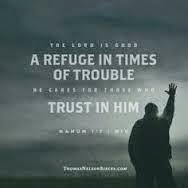
The Lord is good, a stronghold in the day of trouble; he knows those who take refuge in him.

The Lord knows His people.  In the final day of trouble when the Son comes to bring vengeance upon the earth, the only ones who will stand on that day are those who have One standing in front of them. The Lord is good, a stronghold in the day of trouble.

            The Lord will have the last word over our life.  Will the last word you hear be “well done my good and faithful servant” or “depart from me, I never knew you, you worker of lawlessness (Matt. 7:23; 25:23)?


[1] Cited in Dever, Mark. The Message of the Old Testament: Promises Made. Pg 919.
image credit (https://encrypted-tbn3.gstatic.com/images?q=tbn:ANd9GcT864jcQbailDihCHgoVZ-pCQSB5UnCOEo0SgfiQuD-vKBMOVGAWQ)
image credit (https://encrypted-tbn1.gstatic.com/images?q=tbn:ANd9GcTKquR7Cj8WEVZwjag2RjbZF67CyRnV8wfK0UAEtCwxrsEJuRvU6w)
image credit (http://media-cache-ak0.pinimg.com/236x/56/3e/4a/563e4abba23ea37296f31709abc7ab42.jpg)

Tuesday, September 30, 2014

Day Old Toast


For this reason, because I have heard of your faith in the Lord Jesus and your love toward all the saints, I do not cease to give thanks for you, remembering you in my prayers, that the God of our Lord Jesus Christ, the Father of glory, may give you the Spirit of wisdom and of revelation in the knowledge of him, having the eyes of your hearts enlightened, that you may know what is the hope to which he has called you, what are the riches of his glorious inheritance in the saints, and what is the immeasurable greatness of his power toward us who believe, according to the working of his great might that he worked in Christ when he raised him from the dead and seated him at his right hand in the heavenly places, far above all rule and authority and power and dominion, and above every name that is named, not only in this age but also in the one to come. And he put all things under his feet and gave him as head over all things to the church, which is his body, the fullness of him who fills all in all. (Ephesians 1:15-23)

Beloved,

Have you eaten a piece of toast that was left out over night?  It still is toast, but it does not taste the same.  Its staleness deadens the richness of the flavors.  It can still offer some nourishment, but it lacks freshness and vitality.  The prayer life of many Christians is like day old toast.  It still may offer some nourishment, but it is not satisfying. Prayer with the Triune God should not be stale, but vibrant and rich. 

One of the best ways to overcome a stale prayer life is to dig into the plethora of prayers in the Bible. For example, read the prayer of the Apostle Paul above.  It is rich with deep gospel truths and precious promises God has given his people.  Paul prays for the Spirit to give wisdom and revelation to the saints so we can grasp the riches of our future inheritance.  He prays of the immeasurable greatness of God’s power demonstrated in Christ’s victory over the grave that God is fully able to fulfill His promises. 


Reading this prayer fills my heart with eternal hope built on the gospel of the Lord Jesus Christ.  Paul’s prayer is beautiful and soul-inspiring, and yet, it is only one of the countless examples of what we should pray in God’s Word.

image credit (http://www.stacatholic.org/media/1/prayer%20request%20image.jpg)