Monday, February 24, 2014

Is Church Membership Biblical?


Tony is a loving father and a caring husband. He became a Christian at a young age.  He is a faithful employee and has always been faithful to his local church…until he started to notice a lot of problems within the congregation.  He grew tired of seeing the conflicts with other Christians. It appeared to him also that the church wasted a lot of resources. He knew a big building with a beautiful sanctuary took a lot of money to maintain, and he believed the church should be spending more of their resources on missions.  He became discontented with what he saw, so he pulled his family out of the church. He now prefers to do his own thing with his family at home on Sunday.
Susan was a devoted minister in a para-church organization. She regularly shared the gospel with lost teenage girls at nearby community center where she volunteered. She was not raised in the church, but came to know the Lord with a friend who lived on her hall during her freshman year in college. She loves reading the Bible with her friends, but has never seen the value of the local church.
George does not have a problem with the church, but does not get anything out of the sermon.  He believes that one can worship God anywhere and he finds his greatest enjoyment in playing golf with his friends on Sunday morning. They pray before the round begins and talk about family and God between shots.  They even occasionally invite one of their non-Christian neighbors to join their foursome in the hopes of talking to them about Jesus. 
The church has fallen on hard times.  I have a lot of conversations with people who are Christians, who believe the Bible, but do not see the value of the local church. They view church membership more as a distraction and inconvenience, rather than a biblical command. And knowing their experience in the church and knowing how many unhealthy churches exist, I can understand their perspective. They say things like, “I do not need the church or You can be a Christian without the church.”  They are correct. You can be a Christian without the church, but can you be a faithful Christian? Or another way to ask the question would be, “Is church membership biblical?”  (Granted, there are faithful Christians living in other parts of the world where there is no church within 100 miles because they may be one of the only believers in the area. This is the rare exception and not the rule, and certainly not the case here in South Carolina).
“Thou shall become a church member.” This verse is not in the Bible.  There is no explicit reference that an individual should be listed on a Church membership roll.  Although there are not explicit references to church membership that does not mean the idea of church membership is not in the Bible.  It is not only implied in the Bible, but the New Testament concept of “church” does not make sense outside of church membership. We are going to look at the biblical foundations of church membership. 

The Keys of Church Membership

            The first reference to church in the New Testament is in Matthew 16.  Jesus just warns his disciples about the leaven of the Pharisees. He then asked his disciples,
“Who do people say that the Son of Man is?” 14 And they said, “Some say John the Baptist, others say Elijah, and others Jeremiah or one of the prophets.” 15 He said to them, “But who do you say that I am?” 16 Simon Peter replied, “You are the Christ, the Son of the living God.” 17 And Jesus answered him, “Blessed are you, Simon Bar-Jonah! For flesh and blood has not revealed this to you, but my Father who is in heaven. 18 And I tell you, you are Peter, and on this rock I will build my church, and the gates of hell shall not prevail against it. 19 I will give you the keys of the kingdom of heaven, and whatever you bind on earth shall be bound in heaven, and whatever you loose on earth shall be loosed in heaven.” 20 Then he strictly charged the disciples to tell no one that he was the Christ. (Matthew 16:13b-20, ESV)

In verse 18, we see the first reference in the New Testament of the church: the word is ekklesia, which means gathering.  It is taken from the Hebrew word, qahal, which means assembly.  We cannot read too much into this statement, because church has not yet been established when Jesus said it. (The church was established, however, when Luke wrote this gospel.)  We can at least establish that the basic meaning of the word indicates that Jesus intends for his people to gather together in worship as they did in the Old Testament.  One essential aspect of the church is the gathering of the people of God in worship.
Also, in verse 18, Jesus says that on this rock he is going to build his church and the gates of hell will not prevail against it.  The question is what does Jesus mean by “on this rock I will build my church”?  Is he referring to Peter, Peter representing the apostles, Peter’s confession of Christ or Jesus Christ, Himself?
            In the Greek there is a word play here with Peter, Petros, and rock, petra. Many scholars want to dismiss the connection between Peter being the rock because they do not agree with the apostolic succession of the Catholic Church.  The idea of the pope in Roman Catholicism is birthed from this passage.  Although I do not think one can make the biblical argument for apostolic succession from this passage, I do believe the most natural reading is that Jesus is referring to Peter. We know that Peter was there at the founding of the church in Acts 2.  He preached the gospel of repentance by faith in Jesus Christ as the only way to salvation and 3,000 souls were saved.  The foundation of the church (at least in some way) was built upon the Apostle Peter, but it was also built upon his profession of faith. 
            Peter responded correctly in properly identifying Jesus Christ.  When asked who Jesus was, Peter responded, “You are the Christ, the Son of the living God.” This confession is the foundation of the church because Jesus the Christ is the head of the church.  He is the Anointed One, the Messiah, the Christ of God.  The only way anyone enters into fellowship with the church of Jesus Christ is confessing that Jesus is the Christ, the Savior of the world; to have fellowship with the church is to have fellowship with Jesus Christ.  Listen to 1 Corinthians 1:9, when Paul says to the church of God at Corinth (a specific local visibly identifiable congregation), “God is faithful, by whom you were called into fellowship of his Son, Jesus Christ our Lord.” Peter could also be referred to as the representative of the apostles. He was one of the prominent leaders of the church throughout the gospels and played the leading role in the first 12 chapters of Acts.  The teaching of the apostles and the prophets are referred to as the foundation with Christ being the cornerstone in Ephesians 2:19-21,
So then you are no longer strangers and aliens, but you are fellow citizens with the saints and members of the household of God, 20 built on the foundation of the apostles and prophets, Christ Jesus himself being the cornerstone, 21 in whom the whole structure, being joined together, grows into a holy temple in the Lord. 
And again in Revelation 21:14, we see John describe the New Jerusalem,
And the wall of the city had twelve foundations, and on them were the twelve names of the twelve apostles of the Lamb. 
The rock in which the church will be built is on the teaching and the confession of Jesus Christ as Lord done through the Peter and the apostles. 
            And we see the tremendous power given to the apostles through their preaching and teaching ministry in Matthew 16:19,
I will give you the keys of the kingdom of heaven, and whatever you bind on earth shall be bound in heaven, and whatever you loose on earth shall be loosed in heaven. 
This binding and loosing refers to a person’s acceptance into the kingdom of God and into the church in accepting or rejecting the teaching of the apostles on the person and work of Jesus Christ.  He has given the church the tremendous responsibility of being stewards of the mysteries of God. The keys of the kingdom of God are given to the church in the proclamation of Jesus as the Christ, the Holy One of God.  (The idea of “loosing and binding” we see here, I will discuss further in few weeks when we address church discipline.)
It takes keys to enter a locked door.  The door to heaven is locked from humanity because of our sin against God. Our sin has separated from God and shut us out of the kingdom of heaven.  Our sin keeps us outside of God’s fold and if we stay there, we will perish.  But God sent his son to give us a door into his kingdom.  John 10,
7 So Jesus again said to them, “Truly, truly, I say to you, I am the door of the sheep. 8 All who came before me are thieves and robbers, but the sheep did not listen to them. 9 I am the door. If anyone enters by me, he will be saved and will go in and out and find pasture. 10 The thief comes only to steal and kill and destroy. I came that they may have life and have it abundantly. 11 I am the good shepherd. The good shepherd lays down his life for the sheep. (John 10:7-11, ESV, emphasis added)
The only way to enter into God’s kingdom is through the door of the Lord Jesus Christ.  The church has been given the keys of kingdom in that we tell people the good news of the Good Shepherd who laid his life down for the sheep.  Jesus Christ lived a perfect life and died a sinner’s death.  His death paid the penalty for sin absorbing God’s wrath on the cross.  And after he was dead and buried, God raised Jesus from the dead conquering death for all those who would trust in him.  If you are here today and have not entered through into the kingdom through the door of Jesus Christ, you can today.  Turn from your sin and trust in Him.  He came to give you a way into the kingdom.
            From these verses, we can establish that Jesus wants his people to gather together (ecclesia) and to hear the teaching of Jesus Christ so that people can confess that Jesus is the Christ and be saved.  We also see here that the church is Jesus’s idea.  It was not invented by the apostles, but was established by the Lord himself.   
            But isn’t Jesus referring to the universal church? Jesus is not saying that I should be a member of the local church.  Let’s answer that through how the rest of the New Testament teaches this principle.

The Images of Church Membership

            The New Testament uses a variety of images to identify and explain the church.  One pastor explains it this way:
God has inspired multiple images, each of which offers different perspective and none of which should so dominate our conception of the church that the depth and texture of understanding is lost. Though all are inspired, they are not interchangeable, nor are they all as comprehensive in their presentation of the nature and mission of the church…None of these images negates the institutional aspects of the church, but their number and variety point to a degree of mystery in the nature of the church. [1]
None of the images of the church negate the institutional aspects of church.  We are never called to God
alone, but also to his people. 

The Body of Christ

 The church is called the body of Christ. In 1 Corinthians 10:16-17, Paul writes about communion in the church, “The bread that we break, is it not a participation in the body of Christ. Because there is one bread, we who are many are one body, for we all partake of the one bread.”  And again 1 Corinthians 12:12, “For just as the body is one and has many members, and all the members of the body, though many, are one body, so it is with Christ.” Then after describing how this idea of membership creates unity, Paul writes 1 Corinthians 12:18, “But as it is, God arranged the members in the body, each one of them as he chose.  If all were a single member, where would the body be? As it is, there are many parts, yet one body.” Romans 12:4-5, “For as in one body we have many members, and the members do not all have the same function, so we, though many, are one body in Christ, and individually members one of another.”  The body image is extensive in the New Testament. 
            And all those references are specifically written to a specific visible local body of believers.  Most of the books we have in the New Testament are written to churches. Romans 1:7, “To all those in Rome who are loved by God and called to be saints” 1 Cor.1:2 & 2 Cor. 1b, “To the church of God that is in Corinth.” Galatians 1:2b, “To the churches of Galatia,” (multiple churches in one region).  Ephesians 1:1b, “to the saints who are in Ephesus.” Paul writes also to the church in Philippi, Colossae, and Thessalonica. And in addition 3 more letters to pastors of a specific, visible local body of believers.  The body imagery is so readily used in the New Testament because it pictures the reality of one specific, visible, local body of believers who have many members, but are one body; the body of Christ.
The same image of “many individual parts with one collective whole” can also be seen the other images in the New Testament. The church is a building with many stones built into a house (Ephesians 2:21 and 1 Peter 2).  The church is one temple with many bricks built into that temple (1 Corinthians 3:16). The church also is referenced multiple times as the people of God, as similarly identified in the Old Testament.  There are many other images the New Testament employs, but they all do not negate the corporate function of individuals.  The people, who disregard the local church, disregard the entire thrust of the New Testament’s teaching on the church. As one pastor said, “Christianity is personal, but never private.”[2] 
            There are also several places where it would appear that there are actually lists of people that would resemble a church roll.  Paul encouraged Timothy (in 1 Timothy 5) to keep a record of the widows that the church was responsible to minister to with financial resources.  In 1 Corinthians 5, Paul encourages the church to put out a sinning member from the church.  How can one be put out of the church unless there is a clear understanding of who was in the church? Again, in 2 Corinthians 2, Paul refers to the “majority” of people who acted in discipline against a member within the church.  There cannot be a record of the majority of the church unless the church had a record of the entire church.  And even God himself apparently has a list.  Revelation 21:27, “But nothing unclean will ever enter it, nor anyone who does what is detestable or false, but only those who are written in the Lamb's book of life” (emphasis added).
            Church membership is biblical.  It may not be explicit, but it is very implicit throughout the New Testament.  You cannot explain certain verses and/or the encouragements and warnings of the New Testament without Christians beings a member of a specific, visible, local church. We must always remember that the church was not the apostles or the early Christians idea, but it was rooted and established in the mind of God.  Jesus said, “On this rock, I will build my church.”  The church is precious to God because as Acts 20:28 says it was, “obtained with his own blood.” Church membership is biblical, but it also a blessing. 

The Blessings of Church Membership

            When you commit yourself to a specific, visible, local church you have church leaders who are committed to protect and care for your soul. God charges elder/pastors to protect the flock in Acts 20. They are called to labor in teaching sound doctrine and guard the flock from wolves that teach heresy.  Elders are called to be examples to the flock, pointing the members of the church to Christ (1 Peter 5).  Committing to a local church allows the church leadership to know who they are responsible to care for and to whom individuals are called to submit.  Hebrews 13:17, “Obey your leaders and submit to them, for they are keeping watch over your souls, as those who will have to give an account.”  Two things you should see in that verse, first, church leaders need to know who they will be held accountable for.  As pastors, Bill and I have a unique responsibility to care for the people of this church; as a father will answer for his children, so pastors will answer for their flock. Secondly, it allows Christians to know who they are responsible to obey.  The Bible commands you to obey your leaders.  It is easy to disobey this command simply by not committing.  Our world does not like talk of authority, submission and obedience, but Christians cannot live like the rest of the world.  Christians trust God.  I could give a whole list of caveats here: pastors aren’t perfect; the church has problems; the pastors are too young etc. But without church membership, how do you fulfill this command to obey your leaders and how do you know which leaders to submit?  Church membership is a blessing to Christians as well as Christian leaders.
            The world needs to understand what it means to be a Christian and what it means to be a non-Christian. The lines have been too muddled in the past.  Help clarify to the world what it means to follow Jesus Christ. Commit to a local church.  Church membership makes it more difficult for weaker sheep to go straying from the fold, while still considering themselves sheep.[3] Older Christians can help younger Christians clarify what it means to be a Christian disciple and protect them from walking astray. Church Membership helps guard people’s souls.
            Church membership is not only a biblical command, but it is also a blessing. The church is a family. We are family that God which have been charged to relate with one another in a very particular way.  We are called to love one another. And as a church member we have the great blessing of extending our love to one another and to receive love from one another.  We do not have time now to list all the blessings of church membership, but take a half hour this afternoon with your family and make a list of all the blessings you have and can experience by being committing yourself to a local church? Then pray that those blessings would continue to be the regular experience of the people in the church. Pray that this church would truly be a people, that loves one another.
The arguments that Christians usually give about being part of a church family are rooted in their own past negative experiences in churches.  And likewise, most people love the church because of their positive experiences in being part of a church family.  How we relate to one another will either foster a love for God’s church or cripple it? 
            The church has to raise its standards of church membership. We have to have high expectations for the Lord’s church.  We are fine with people remaining as members of the church when they have not darkened the door in years.  We are fine with people remaining members of the church if they are living in open and outright rebellion against God.  Doesn’t God deserve better than that? Romans 2:24 says, “For, as it is written, “The name of God is blasphemed among the Gentiles because of you.” We should fight for the reputation of our God.  We must commit to the church of the living God which was purchased through the blood of Christ.   Beloved, we have to raise the bar for church membership. Church membership is biblical and God-honoring. I challenge you to obey God’s word by making a commitment and helping others to commit to a specific, visible, local body of believers.  The church is God’s idea.  It is precious to Him, will it be precious to you?


[1] Dever, Mark. The Doctrine of the Church in The Theology of the Church.  P.772-773. Ed. Akin, Daniel. 2007 Academic Nashville, TN
[2] Dever, Mark. Lecture at RTS 2.11.2014
[3] Dever, Mark. Nine Marks of a Healthy Church (Booklet) 2005.IX Marks Washington, D.C.  p. 38

Monday, February 10, 2014

Salvation from Death to Life


In 6th grade, I was part of an elite group of safety conscious protectors of children: the Lincoln Elementary School Crossing Guard Patrol. Each day at the end of school we would get into our uniform, draping the bright orange belt around our chest. It was a badge of honor. We were required to leave school 10 minutes
early in order to be in position when the rest of the children needed to be escorted to safety through the busy streets of Palatine, IL. I served my role as a crossing guard faithfully for two years, never missing a day to protect the lives of my fellow classmates… that is, until the day that I skipped my patrol duty. I had friends coming over after school and figured this would be a great opportunity to skip patrol and prepare my house for my friends. I lived directly behind my elementary school, so I had to be careful not to be seen by my teachers. I remember walking up to the deck on the side of the house and as I reached for the door I looked back at my school. As I looked back I could see one of my teachers staring at me as I entered the house. Busted!!

I received a detention for skipping my patrol duties that day. And it just so happened that a few days earlier, there was an announcement from the principal that any 6th grader who received a detention would not be allowed to go on the 6th grade bowling trip. Well, I got a detention and missed the 6th grade bowling trip, and instead had to write a 5 page paper on the history of bowling with our librarian. It was an awful experience, and to make matters worse, during our graduation a few weeks later, the slideshow that was presented to the families were all of pictures taken during the 6th grade bowling trip. As you can tell, this was a big deal in the life of a twelve year old. I made a decision that affected my life. Now, if you were to tell me before I made the decision to skip crossing guard patrol that I would have missed the 6th grade bowling trip and had to write a 5-page paper on the history of bowling and that I would not be shown in our graduation slide show, I would not have skipped patrol. This event taught me a valuable lesson in that you need to consider the consequences of your decisions. You must think before you act because after you make your decision, you cannot take it back. You have to live with the consequences.

This idea should shape our evangelism. There are eternal consequences for the decisions we make in this life. God gives the unbeliever opportunity after opportunity after opportunity to turn in faith to Jesus Christ, but there will be a day when it will be too late. The Bible says in Hebrews 9:27 that there, “is appointed for man to die once, and after that comes judgment.” If people do not turn from their sin and trust in Jesus Christ as their Lord and Savior, they will be responsible to pay for their own sins. Jesus illustrates this principle when he shares the story of the rich man and Lazarus. The rich man was begging for mercy from Abraham and this is Abraham’s response in Luke 16:25,

Child, remember that you in your lifetime received good things, and Lazarus in like manner bad things; but now he is comforted here, and you are in anguish. And besides all this, between us and you a great chasm has been fixed, in order that those who would pass from here to you may not be able, and none may cross from there to us.’ And he (the rich man) said, “Then I beg you, father, to send him to my father’s house—for I have 5 brothers—so that he may warn them, lest they also come into this place of torment.’

Jesus shows that after death there is no hope of salvation without faith in Christ. The rich man realized that, as he was in anguish and begged that someone would go and tell his family the truth of the life to come. At that moment, in hindsight, the man regretted his decision not to repent and did not want others to make the same mistake that he did. But the story goes on,

But Abraham said, ‘They have Moses and the Prophets; let them hear them.’ And he said, ‘No, father Abraham, but it someone goes to them from the dead, they will repent.’ He said to him, ‘If they do not hear Moses and the Prophets, neither will they be convinced if someone should rise from the dead.’

We must think of the consequences of our decisions before we make them. Even more so, we must consider the reasons we make decisions. We must examine our beliefs. We must help others examine their beliefs, for we want people to experience salvation.

God has given his people a mission to go and make disciples of all nations baptizing them in the name of the Father and the Son and Holy Spirit. This means that we must make disciples of people who do not have a faith in Jesus. We must tell them the way of salvation. This morning we are going to look at three different aspects of salvation, in hopes that we would be encouraged to fulfill our mission to make disciples by going into the world to reach the lost. First, we must understand the problem of salvation.

The Problem of Salvation

Problem of Salvation? How could there be a problem with salvation? The problem of salvation is for the people that do not have it. Salvation is a beautiful and incredible gift, because of what salvation saves us from. Read Ephesians 4:17, “Now this I say and testify in the Lord, that you…” Paul is speaking to believers here. The “you” is referring to the people who have been lavished with the grace of God and the forgiveness from sin through the shed blood of Jesus. The “you” means that salvation is now possible for the Gentiles, who were once far off. He makes the point in Ephesians 2,

Therefore remember that at one time you Gentiles in the flesh….remember that you were at one time separated from Christ, alienated from the commonwealth of Israel and strangers to the covenants of promise, having no hope and without God in the world. But now in Christ Jesus you who once were far off have been brought near by the blood of Christ. For he himself is our peace, who has made us both one…so then you are no longer strangers and aliens, but you are fellow citizens with the saints and members of the household of God. (Eph. 2:11;13-14;19)

The Gentiles that Paul is writing to are Gentiles that have been saved. They have experienced salvation, but there are still Gentiles outside of the faith.

Paul says, “that you must no longer walk as the Gentiles do.” He is now going to unpack the problem of those who have not yet experienced salvation in how the Gentiles walk without God. Hear the problem of those without salvation in verse 17 again, “Now this I say and testify in the Lord, that you must no longer walk as the Gentiles do, in the futility of their minds. They are darkened in their understanding, alienated from the life of God because of the ignorance that is in them, due to their hardness of heart. They have become callous and have given themselves up to sensuality, greedy to practice every kind of impurity.” The unbeliever is in a very dangerous state. Their minds are subject to futility, darkened understanding, and ignorance resulting in alienation from God due to their hardness of heart. Let’s look more closely at each of Paul’s description.

First, Paul says that unbelievers walk in the futility of their minds. Futility means empty, useless, fruitless, or ineffective. Imagine I wanted to dunk a basketball and I tell you that I would be able to dunk a basketball if I changed out of my suit and into gym shorts and brand new Nikes. Would my new clothes have any impact on whether I would be able to dunk a basketball? No. It would not matter what I am wearing or how well I stretch, it would be useless or futile for me to attempt to dunk a basketball. Likewise, the minds of unbelievers are useless and ineffective in their ability to be saved without Jesus Christ. The end of their thinking will get them nothing, but separation from God.

Secondly, Paul says that believers are darkened in their understanding. This does not mean that unbelievers are unintelligent. Many unbelievers are actually quite intelligent and brilliant, even. Although they may be extremely intelligent, they do not understand the world. They are walking in deep darkness. They may appear enlightened as is the claim of modernity, but the Bible says that without Christ, people do not understand rightly. Thirdly and closely related, unbelievers are in ignorance. Before coming to Christ, there was no way for me to understand the nature of the universe. We were created in the image of God to know him, to love him, to live with him, and to glorify him. Therefore, if we are ignorant of our purpose, how can we understand anything else? Ignorance is blinding. And the danger of ignorance is that people are not aware that they do not know the truth.

Fourthly, Paul says that a mind is futile, darkened in understanding, and ignorance will lead to moral degradation. He says that unbelievers give themselves up to sensuality and impurity. Notice how the way one thinks affects how he lives. When people think wrongly, it will result in them living wrongly. I hear a lot of Christians ask, “How can people live like that?” If you ask that question, then you do not fully understand the state of someone who is spiritually lost. “But what about their conscience? Don’t they feel bad for doing wrong?” Paul answers that question for us when he gives the reason for their state at the end of verse 18, “due to the hardness of their heart.” He says it similarly at the end of Romans 1:18 in saying, “who by their unrighteousness suppress the truth.” They may feel guilt or shame, but they hold down those feelings. They do not allow those feelings to invoke change. This will lead to a calloused conscience, which results in more sin. Verse 19, “They have become callous and have given themselves up to sensuality, greedy to practice every kind of impurity.” The longer one suppresses the truth, the more callous his conscience becomes. Sin spirals farther and farther out of control. This is why when you talk to people who struggle with grievous sin; they never expected it to get so far. Sin begets sin. And what is the end result? a life that is alienated from God.

A life that is alienated from God is a life that is destined for destruction in a literal place called Hell. I recently spoke with a high school student from one of our local high schools. During her religious studies class, her teacher said that the Bible never mentions Hell, but it was an invention of the Church to scare people into good behavior. However this teacher is very wrong, for Jesus repeatedly says that those who reject him will be thrown into Hell. Listen to the words of Jesus,

Matthew 22:13, “Then the king said to the attendants, ‘Bind him hand and foot and cast him into outer darkness. In that place there will be weeping and gnashing of teeth.”

Matthew 25:30, “And cast the worthless servant into the outer darkness. In that place there will be weeping and gnashing of teeth.

Matthew 10:28, “Do not fear those who kill the body but cannot kill the soul. Rather fear him who can destroy both soul and body in hell.”

Mark 9:43, “And if your hand cause you to sin, cut it off. It is better for you to enter life crippled than with two hands to go to hell, to the unquenchable fire.”

Matthew 13:49-50, “So it will be at the end of the age. The angels will come out and separate the evil from the righteous and throw them into the fiery furnace. In that place there will be weeping and gnashing of teeth.”

Hell is a very real place and is the destination for everyone who does not have faith Jesus Christ. It may not be an enjoyable topic to discuss, but we must think of the consequences of our beliefs. If we don’t understand the end of the unbeliever, we will never be motivated to share. The problem with salvation is for those who don’t have it. Have you experienced this salvation?

Next, let us look at the process of salvation.

The Process of Salvation

Remember Paul is speaking to Christians. After telling of the state of the unbeliever, Paul goes on in verse 20-21, “But that is not the way you learned Christ!—assuming you have heard about him and were taught in him, as the truth is in Jesus.” Christians had to learn about Christ. They had to hear of him and be taught of him so they would know the truth of Jesus. There is a way out of futility, darkened understanding, ignorance, a life alienated from God due to hardness of heart. It is the way of gospel. It is hearing and believing the good news of Jesus Christ. What is this good news? There is forgiveness and life in Jesus Christ. 1 Corinthians 15:1-3,

Now I would remind you, brothers, of the gospel I preached to you, which you received, in which you stand, and by which you are being saved, if you hold fast to the word I preached to you—unless you believed in vain. For I delivered to you as of first importance what I also received: that Christ died for our sins in accordance with the Scriptures, that he was buried, that he was raised on the third day in accordance with the Scriptures, and he appeared to Cephas, then the twelve.

This is what we share to others. We share what Paul shared: that Christ died for our sins, was buried and was raised. One of the reasons people give for not sharing the gospel is that they are concerned they will be unprepared. Ten words. That is it. Christ died for our sins, was buried, and was raised. The gospel. But is sharing the gospel enough? No. We must call people to respond to it. Jesus said go and make disciples of all nations, baptizing them in the name of the Father, and the Son, and the Holy Spirit. The key word for us is baptizing. People need to come and be baptized. They need to repent and be baptized. Baptism is the public profession of one’s faith, a symbol of their repentance and acceptance of the gospel.

Go back to verse 20, “But that is not the way you learned Christ!—assuming that you have heard about him and were taught in him, as the truth is in Jesus, TO , (listen to the call to repentance) to put off your old self, which belongs to your former manner of life and is corrupt through deceitful desires, and to be renewed in the spirit of your minds, and to put on the new self, created after the likeness of God in true righteousness and holiness.” Knowledge is not enough. People must repent. They must put off the old manner of life and put on the new self in true righteousness and holiness. Any gospel presentation without the call to repentance of sin is not a faithful presentation of the gospel. We must call people to respond to the truth that without Jesus Christ you are alienated from God, but only through his shed blood are you, who was once far off, brought near to God.

Beloved, do you see the importance of the speaking the gospel? Romans 10:13, “For everyone who calls on the name of the Lord will be saved. How then will they call on him in whom they have not believed? And how are they to believe in him of whom they have never heard?” Unbelievers are only saved if they call on him and believe in him. This is the mission of the church. We invite people to call on Jesus Christ for the forgiveness of their sins and for the hope of eternal life through His resurrection from the dead. We cannot be silent. We must not be silent.

We can all admit that sometimes it is difficult to bring up the gospel in conversations. There are a plethora of reasons that we can all give for not sharing the gospel, but are those reasons more important than someone going to hell? We have to remember that this is good news. The Bible says, “How beautiful are the feet of those that bring good news (Romans 10:15).”

Lastly, we cannot forget that God has not called us to simply share the gospel, but to picture it.

The Picture of Salvation


How we interact as a congregation pictures the gospel to the watching world!!! Paul unpacks what the life of a believer of Jesus Christ will look like in relationship with other believers. Listen to verse 4:25 to the end of the chapter,

Therefore, having put away falsehood, let each one of you speak the truth with his neighbor, for we are members one of another. Be angry and do not sin; do not let the sun go down on your anger, and give no opportunity to the devil. Let the thief no longer steal, but rather let him labor, doing honest work with his own hands, so that he may have something to share with anyone in need. Let no corrupting talk come out of your mouths, but only such as is good for building up, as fits the occasion, that it may give grace to those who hear. And do not grieve the Holy Spirit of God, by whom you were sealed for the day of redemption. Let all bitterness and wrath and anger and clamor and slander be put away from you, along with all malice. Be kind to one another, tenderhearted, forgiving one another, as God in Christ forgave you.

Paul describes how Christians are supposed to interact together in the local church. Speaking truth to one another, showing mercy towards each other, working to give to one another, letting go of bitterness towards one another, not allowing slander to be spoken by each other, and forgiving one another as God has forgiven us in Christ. People may refute our beliefs, they may mock our creeds, but they cannot dismiss our love for one another. Jesus said, “A new commandment I give to you, that you love one another: just as I have loved you, you also are to love one another. By this all people will know that you are my disciple, if you have love for one another (John13:34-35).”

Let me close with a story that illustrates this principle from someone’s personal experience, Jason Helopolous writes about how the Lord used the “strange love” of the church to draw him to Christ:

As a freshman college student and self-declared atheist, I attended a campus Christian fellowship to fulfill a promise to a Christian friend. I only had the intention to go once. It was merely duty and upholding my word, nothing more. I went begrudgingly, but I went. My life was never the same.

I walked into a room full of Christians and was struck by what I observed. Here was a diverse group. They were from every walk of life. I remember scanning the room and labeling people in my mind, “There is a jock, over there is a geek, and walking in the door is a boy scout.” But what struck me was that they were together. They weren’t just together in the same room, they were together in every sense of the word. They were actually talking with each other and genuinely seemed happy to be together. There didn’t seem to be division. Even in my atheist mind, I knew what I was seeing: they loved one another.

I had no categories for this, so I kept returning to find out why they had love like this for one another. Over the course of a few months I found the answer, or more accurately stated, the answer found me.

 One of the best evangelism programs you can start at your church is to pursue loving one another well. At some point they will have to hear the gospel proclaimed from your lips or the pulpit, but that “strange love” will set the table before them. People will know that you are His disciples, because it is a shocking love. It has a gravitational attraction, because it is a love that is foreign to this world. A love that the inquirer, if seeking an answer, will find comes from heaven[1].

Beloved, God has given us a mission to make disciples by baptizing them in the name of the Father, and the Son and the Holy Spirit. God uses many means to draw people to Christ, but two primary ways are the gospel proclamation and the gospel life of a local church. Beloved, let us be a church that lives out a faithful gospel witness in word and deed.


Tuesday, January 28, 2014

Equipping the Saints


After graduating from high school, my parents rewarded me with a backpacking trip to British Columbia Canada. We arrived early one morning via Ferry to the small town of Egmont, where we took a vehicle to base camp. Upon arrival at the basecamp, we met our two guides, Mark and Brian. They sat us down and proceeded to equip us with all the materials needed for the trip. We had to make sure we were equipped with the proper clothing for the cold weather. We had to have the right amount of food. We had to be equipped with the right tools in order to climb the mountain that stood before us. One of the tools we received was an ice axe. Although I grew up in the frigid cold of the Windy City, I had never seen or touched an ice axe before that moment. As a teenage boy, there was nothing more thrilling to be equipped with an ice axe to conquer the rough, mountainous terrain. Young men were made for adventure. Although I was equipped with the right tool and excited for the journey, I still needed to be equipped with the knowledge of how to use the new tool. Mark and Brian were tasked with teaching us how to use this ice axe, because if we were going to be successful on our mission of conquering the mountain, we were going to have to use our new tools properly.

The key to the ice axe was not having it in our possession, but being able to use it on our journey. The tool would have been meaningless if we had stayed at basecamp. We had a mission to climb a mountain and needed to be equipped with the right tools. Likewise, Christians have been given a mission from the mountain top (the Great Commission) and need to be equipped with the right tools. The purpose of equipping young men with tools to conquer a mountain was never meant for them to remain at basecamp. We had to go to complete our mission. Likewise, the saints of God must be equipped for our mission, not to merely possess tools of knowledge, but to use the tools to complete our mission. We have been called to make disciples of Jesus by baptizing and teaching, by edifying and evangelizing. Today we are going to look more at making disciples specifically by edifying the saints. My prayer is that you would be encouraged and challenged this morning to be equipped for the adventure of following Jesus Christ in making disciples of the nations. I pray that we understand that our mission is never to come and sit next to each other on Sunday morning, but to come to be equipped in making disciples of Jesus Christ to the glory of God the Father. We are not called to sit at our basecamp, but to conquer the kingdom of darkness with the light of the glorious gospel of our Risen Lord. First, our mission is to help equip the saints to build the Body.

I. Equipping the Saints to Build the Body

The local church is very precious to God. This letter is written to the saints at Ephesus. It was written to a local body of believers. During the first three chapters, Paul unpacks the glorious gospel of Jesus Christ. Paul writes in 1:7, “In him we have redemption through his blood, the forgiveness of our trespasses, according to the riches of his grace, which he lavished upon us, in all wisdom and insight.” We have forgiveness of our sins and redemption through the blood of Jesus. He spends the first three chapters unpacking the “riches of his grace” that he has “lavished upon us.” The beginning of chapter 4, he starts to unpack the practical implications of this abundant grace. Verse 4:1, “I therefore, a prisoner for the Lord, urge you to walk in a manner worthy of the calling to which you have been called.” So the rest of this letter shows us how to walk in the manner worthy of our calling. One aspect of that calling is to be faithful to the mission that God has given us.

Look at verse 11, “And he gave the apostles, the prophets, the evangelists, the shepherds and teachers, to equip the stains for the work of the ministry, for building up the body of Christ.” See the heart of God for the building up of his people in that He gave the apostles, the prophets, the evangelists, the shepherds and teachers. God has a plan to build up his people. He has decided in his wisdom to give gifts to the church so they can be equipped for the work of the ministry. The professionalization of Christian ministry has hurt both pastors and Christians in the local church. The professionalization of the ministry has allowed Christians to forsake their calling to do the work of the ministry. Many Christians feel that they are excused from laboring in the cause of Christ because they help to support the “professional Christian” to do the work of the ministry. While professionalism often gives vocational pastors a sense that they are more important than the “average Christian” in the pew. Both are lies from the very depths of Hell. Pastors are given as gifts for God’s beloved. Pastors labor not to exalt themselves as intelligent or wise, but as slaves for Jesus Christ for the people’s sake. Pastors live to be poured out as a sacrifice in order that others may be equipped to join in the joy of ministry. Don’t miss this. God is behind the church. God wants his people built up. He has set up the church. God tells us to make disciples of all nations and then gives gifts (teachers and shepherds) to the church in order for them to accomplish their mission. God wants you to do the work of the ministry.

If you only come to church to sit and listen, then you do not understand the purpose of the church. If you only come to the church for your own walk with God, then you do not understand the purpose of the church. Just think about it. God gives you teachers so you can be equipped so you can do ministry. God gives you teachers to equip you to serve and complete His mission. So if your end goal in coming to church is not to learn how you can do God’s work and encourage others, then you misunderstand why God created the church. God wants you not only to do his work, but to feel the joy and the majesty that comes along with serving Jesus.

I remember climbing that mountain in Canada and walking through the clouds. Standing at what felt like the top of the world, gazing out over a sea of clouds only to see a small peak in the distance of another mountain. I remember standing at the edge of the cliff and gazing down into a beautiful, lush, green valley. I remember sleeping outside bundled up in a sleeping bag gazing at the majesty of the stars so close that you felt you were in space. Now what if I stayed at the basecamp? Would I have experienced the exhilarating joy that came with gazing at God’s world from the top of that mountain? God is calling you to do the work of the ministry, because he wants you to experience the profound and glorious joy that accompanies that service.

I served as a missionary with the Fellowship of Christian Athletes in Washington, D.C. One of our ministries was to take kids to camp every summer where they could improve in their sport and learn about Jesus. My last year serving in that ministry, we received a donation of $20,000 to take 50 kids to camp. The kids we took to camp that year were from the inner city, and it was the first camp trip for many of these children. It was also the first time many of these children heard about Jesus. Camp was fun, but camp was hard. We started our days at 6 am with prayer, and then moved to a full day of activities, before ending the day crashing in bed around midnight. It was exhausting. The last night of the camp, the speaker shared the gospel and invited students to come forward and make a public commitment to Jesus Christ. I looked and I saw tons of the kids that I brought from inner city Washington, D.C. go forward to follow Jesus. I remember my heart was so filled with joy that I just started weeping. How good was God in allowing me to participate in those kids salvation? As I was crying a young man came back after going forward and hugged me thanking me for bringing him to a camp to meet Jesus. Beloved, that camp was exhausting, but it was also glorious.

God has given you shepherds and teachers in this church to equip you for the work of the ministry for the building up of the body of Christ. God wants you to build up the members of Park Baptist Church. Each of you has been given grace according to the measure of Christ to build up the body (4:7). So in what ways are you building up the body? How are you using your gifts to push others towards Jesus? I could list a variety of ways in which you can build up the body here at Park, but one of the main reasons people neglect building is a lack of love. If you love someone, then it is natural for you to work for their good. When we love others, we are also loving God by trusting his purpose disclosed in his Word for the church; being equipped for the work of the ministry in building up the body. So love the people of God by wanting to build them up for their good and for God’s glory. So ask yourself, how can you better love God by loving his people? How can you intentionally work to build up others?

Many of you do not need to be encouraged to build, but to encouraged to continue to build. Those of you who labor so faithfully to build others up, please do not grow weary. Hear this exhortation from Galatians 6:9-10, “And let us not grow weary of doing good, for in due season we will reap, if we do not give up. So then, as we have opportunity, let us do good to everyone, and especially to those who are of the household of faith.” Your labors will reap a harvest. Take heart and do not give up.

II. Equipping the Saints to Conform to Christ

There is an ultimate purpose in our labors in the body of Christ. We are laboring for the glory of God by helping people be conformed into the image of Christ. Listen to Romans 8:29, “For those whom he foreknew he also predestined to be conformed to the image of his Son, in order that he might be the firstborn among many brothers.” The destination of all Christians is to be conformed into the image of the Son and this brings glory to Jesus Christ. The purpose statement in Romans 8:29 says that we are conformed to Christ, “in order that he might be the firstborn among many brothers.” When we are conformed to Christ, we display the glory of the gospel of Jesus Christ. Jesus came to live and die and be raised in order that he would be the firstborn. Jesus’s position as the firstborn implies that there would be others to come after him. This is our confidence, that as Christ was the firstborn from among the dead so we will also be born again from the dead (Col 1:18). And as we are conformed into the likeness of Christ as ones who have the firstfruits of the resurrection evidenced by the Spirit, then others will have confidence that they too can experience the resurrection from the dead. As we are conformed to Christ, we display the truth of the gospel. We, then, work to build up others into the image of Christ, then they display the truth of the gospel. This is a truth that is repeated throughout Scripture and seen in our text this morning.

Ephesians 4:12 says, “to equip the saints for the work of the ministry, for building up the body of Christ, until we all attain to the unity of faith and of the knowledge of the Son of God, to mature manhood, to the measure of the stature of the fullness of Christ” (author’s emphasis). And again in verse 15, “Rather, speaking the truth in love, we are to grow up in every way into him who is the head, into Christ.” The end goal of our labors in building others up is to help people grow into the image of Christ. As people are conformed to Christ, then the glory of Jesus Christ is manifested to the entire world.

Idolatry was a very common theme in the Old Testament. Followers of false gods worked to extend the influence of their false gods threw the creation of images made of stone or wood. They believed that the more images that were created symbolized the power and influence of the image-bearer. God strictly forbid the creation of images carved in his image for we read in Exodus 20:3-5a, “You shall have no other gods before me. You shall not make for yourself a carved image, or any likeness of anything that is in heaven above, or that is in the earth beneath, or that is in the water under the earth. You shall not bow down to them or serve them, for I the Lord your God am a jealous God.” By creating images, man was rejecting the supremacy of the one, true and living God for God had already made images for the world. Genesis 1:27, “So God created man in his own image, in the image of God he created him; male and female he created them.” The creation of man in the image of God displays the greatness of God for his image fills the whole world.

After God created man in his own image, he beheld all that he had made and saw that it was very good (Gen 1:31). Although man was created in God’s image to reflect his glory, man fell into sin, corrupting his image and reflection of God. Therefore, God sent his son in the likeness of sinful flesh, and for sin to condemn sin in the flesh. Jesus came to crucify sin in the flesh. He was dead and buried, but God raised him from the dead as the firstborn from the dead. So now everyone who turns from their sin and trusts in Jesus Christ as Lord, will be saved and bear the image of Christ. 1 Corinthians 15:47-49, “The first man was from the earth, a man of dust; the second man is from heaven. As was the man of dust, so also are those who are of the dust, and as is the man of heaven, so also are those who are of heaven. Just as we have borne the image of the man of dust, we shall also bear the image of the man of heaven.”

Beloved, if you do not care if others who bear the image of Christ are being conformed into his likeness, then you do not care if the glory of Jesus Christ is manifested to our world. When we do not work to build others up into our head, into Christ, then we are limiting the manifestation of the glory of Jesus Christ to a lost and dying world. The job of building is not given to “professional” Christians, but to the whole body. We have to enlarge our vision of the church. We have to enlarge our desire to see the glory of Jesus Christ manifested in the church. Listen to verse 15-16, “Rather, speaking the truth in love, we are to grow up in every way into him who is the head, into Christ, from whom the whole body, joined and held together by every joint which it is equipped, when each part is working properly, makes the body grow so that it builds itself up in love.” The Holy Spirit says through Paul that when each part is working properly or when each member works to build others up, the whole body grows and is built up in love. Do not sit on the sidelines, but participate in manifesting the glory of Jesus Christ by helping others bear the image of Christ so that in building others up you will also bear the image of Christ who was the firstborn among many brothers.

III. Equipping the Saints to Tell the Truth

Now that you know the importance of building up others to be conformed to Christ to manifest his glory, we have to ask: how do I do that? The answer is simple: tell the truth. We speak the truth of God’s Word to one
another. I am going to read this passage again and I want to point out how often Paul refers to thinking on God’s truth and then speaking God’s truth. Ephesians 4:11-25:

“And he gave the apostles, the prophets, the evangelists, the shepherds and teachers, 12 to equip the saints for the work of ministry, for building up the body of Christ, 13 until we all attain to the unity of the faith and of the knowledge of the Son of God, to mature manhood, to the measure of the stature of the fullness of Christ, 14 so that we may no longer be children, tossed to and fro by the waves and carried about by every wind of doctrine, by human cunning, by craftiness in deceitful schemes.15 Rather, speaking the truth in love, we are to grow up in every way into him who is the head, into Christ, 16 from whom the whole body, joined and held together by every joint with which it is equipped, when each part is working properly, makes the body grow so that it builds itself up in love. 17 Now this I say and testify in the Lord, that you must no longer walk as the Gentiles do, in the futility of their minds. 18 They are darkened in their understanding, alienated from the life of God because of the ignorance that is in them, due to their hardness of heart. 19 They have become callous and have given themselves up to sensuality, greedy to practice every kind of impurity. 20 But that is not the way you learned Christ!—21 assuming that you have heard about him and were taught in him, as the truth is in Jesus, 22 to put off your old self, which belongs to your former manner of life and is corrupt through deceitful desires,23 and to be renewed in the spirit of your minds, 24 and to put on the new self, created after the likeness of God in true righteousness and holiness. 25 Therefore, having put away falsehood, let each one of you speak the truth with his neighbor, for we are members one of another. (italicized author’s emphasis).

So in order to make disciples, we must tell the truth and in order to tell the truth you must possess two things: knowledge of the truth and relationships with people. First, you must grow in the knowledge of the truth. You must commit yourself to studying the Word and to be equipped with the Word. We provide 4 organized opportunities every week for you to hear the Word: Wednesday Night, Sunday School, Sunday Morning and Sunday Evening Worship. Take advantage of those opportunities to be taught the word. Pastor Bill and I are here to help you grow in the knowledge of the Lord. If you do not understand something and want to grow in particular knowledge, please seek us out. Call us or email us. Use our training and knowledge in the Word to equip yourself in truth. Allow me a moment to expose a lie that some of you may believe: “I can’t talk to my pastor because he is really busy and I don’t want to burden him with my problems.” God has raised up shepherds and teachers for your sake. We are here for you. If you are struggling, do not struggle alone. Please know how much of an honor it is to serve you, do not feel you a burden, for you are our joy. For we echo Paul’s words, “For what is our hope or joy or crown of boasting before our Lord Jesus at his coming? Is it not you? For you are our glory and joy (1 Thess. 2:19-20).”

Secondly, you must have relationships with people. If you are going to fulfill God’s mission in making disciples through the edification of the saints, you must know the saints. Life is short and time is valuable. We only have so much time and energy at the end of the day, so we have to be careful about where we invest our time. That being said, God believes that building up the body of believers in the local church should be a top priority for his people, so it is vital that we use our precious time to invest in the lives of others. Invest your time into others and then be patient and allow God to grow you closer together. Remember the ultimate purpose in investing in others is to them conform to Christ and manifest the glory of Christ to the world. This is no small matter.

During my hike in the mountains, the team approached a section of the mountains that was extremely steep. At the bottom of this section was a huge crevice. The only way we could effectively cross was to tie a rope between three different team members. We were all equipped with our ice axes and our desire to complete the mission. I was tied to my two best friends whom I loved more than life itself. As we walked along this steep embankment, one of the friends lost his footing and he started to slip. The two of us who were tied to him threw our ice axes into the wall of snow next to us and held him up. The only way we survived our mission to climb that mountain and avoid the dangers that were in our path was by being equipped with the right tools, the right knowledge and each other. Beloved, the only way we can fulfill our mission in making disciples of one another is to be equipped with the right tools, the right knowledge and each other. Beloved, I urge you to build the body of Christ to help others be conformed to the image Christ by telling one another the truth about Christ to spread the glory of our Lord Jesus Christ.

The Very Good Beginning


And God saw everything that he had made, and behold, it was very good. And there was evening and there was morning, the sixth day. Genesis 1:31

Beloved,

The other day my son went out to get the paper. Before he made it down the driveway, he came running back in the house. “Hey, you have to come see this. The sun is rising and the sky is beautiful. Come on outside.” He was mesmerized by the beauty of God’s
creation. He saw what God had made and exclaimed, “It was very good.” Beholding God’s creation and recognizing its beauty rightly acknowledges God’s power and divine nature. God has created a world that was very good and that flourished under his loving rule.

God’s very good creation has now been corrupted by sin and is in bondage to corruption. Although our world is decaying, we know that creation itself waits with eager longing to be set free from this bondage to obtain the freedom of the glory of the children of God. As Jesus Christ has freed us from the fear of death through his death and resurrection, creation also will one day experience the rebirth into its former “very good” glory. What a day that will be for the children of God!!!

As we wait for that day, we must live under God’s loving rule. God created a universe in such a way to cause humanity to flourish. Every time we reject the order of God’s creation, we lose our ability to flourish. God is smarter than us. He created a world that would maximize human flourishing. Although it has been corrupted now, the children of God still choose to live under the loving rule of our Creator King. For Jesus Christ all things were created. He is before all things and in him all things hold together (Col 1:16-17). When we hold fast to Jesus and His Word, we see a world that is held together in peace and order. When our world rejects Jesus and His Word, we see the unraveling of peace and order. We are not smarter than God. His Word will always prove itself true so that he will be justified in his words and prevail when he is judged (Psalm 51:4).


Let us trust the order and beauty of God’s very good creation, for God saw everything that he had made and behold, it was very good. God knew what he was doing in the creation. Let us not look for new ways to live, but rather let us trust the old way that God gave us in the very good beginning.

Wednesday, January 22, 2014

The Power of the Mind (Exodus 1)


55 Million. 55 million Americans have lost their lives since 1973. 55 million children have been killed through the legal act of abortion. 55 million. That is almost 6 times the number of deaths in the Holocaust. That is an average of 1.2 million children killed every year, which is twice as much as the next leading cause of heart disease. Abortion is the greatest travesty in American History. Over 55 million children have been aborted. 55 million sons and daughters have been killed. The number almost doesn’t seem real. But, beloved, it is very real. It is easy to become numb to a number like that, but we must allow that number to become alive to our hearts. We must know that every one of those 55 million children was fearfully and wonderfully made in the image of God. Everyone one of those 55 million children has an eternal soul that will never die. Everyone one of those 55 million children were precious in the sight of God. Let the number become real to us, for if the number is not real, we will never be motivated to act.

But no matter what we think of abortion, it is not the unforgivable sin. With the number as high as 55 million, it is safe to say that we or someone we know have been impacted by abortion. The statistics show that one of 3 women in America or 30% have had an abortion before the age of 45. This also means that 30 % of men have had a part of an abortion. Abortion’s reach is vast, so before we even go any further, we need to know that God is merciful and gracious, slow to anger and abounding in steadfast love and faithfulness. The sin of abortion is not outside the grace of Jesus Christ. For Jesus Christ died to pay for all of your sin; even the sins that you may have a hard time forgiving in yourself or forgiving in others, for even those are forgiven in Christ. Allow the flowing fountain of God’s grace to cover you this morning so you know that all of your past, present, and future sins were paid for in the cross of Calvary. Christian, abortion is not the unforgivable sin for Jesus, himself, asked God to forgive those who crucified and killed him, “Father, forgive them, for they know not what they do (Luke 23:34).” There is room at the cross for you.

Let us look at the power of the mind. It is hard to underestimate the power of our thoughts. 2 Corinthians 10:4-5 says, “For the weapons of our warfare are not of the flesh but have divine power to destroy strongholds. We destroy arguments and every lofty opinion raised against the knowledge of God, and take every thought captive to obey Christ.” Where we set our minds is of utmost importance!! Romans 8:5-6, “For those who live according to the flesh set their minds on the things of the flesh, but those who live according to the Spirit set their minds on the things of the Spirit. For to set the mind on the flesh is death, but to set the mind on the Spirit is life and peace.” Gathered here this morning, there is a variety of people on the political spectrum, but this is not primarily a political conversation; it is a biblical and moral one. My prayer this morning is that you would set your mind on the things of God, for if we do not set our minds on the Lord, it will be on the flesh. And the mind set on the flesh is death, which is our first point this morning; the mind set on the flesh is death.

The Mind Set on the Flesh is Death

Exodus 1:8, “Now there arose a new king over Egypt, who did not know Joseph.” We remember how God used Joseph to help Egypt during the famine in the interpretation of Pharaoh’s dream. Joseph was eventually promoted to run the Egyptian kingdom under Pharaoh. During the famine, Joseph’s family was brought to the land and lived there under Pharaoh’s blessing. But we see here a new King arose over Egypt that did not know Joseph. In not knowing Joseph, he did not know of Joseph’s God. He did not know of Yahweh and how, through Joseph, Yahweh saved the people of Egypt. So we see a ruler who has his mind set, not on the things of God, but on the things of flesh. Watch the result of the mind focused on the flesh.

Verse 9, “And he said to his people, “Behold, the people of Israel are too many and too mighty for us. Come, let us deal shrewdly with them, lest they multiply, and if war breaks out, they join our enemies and fight against us and escape from the land.” Therefore they set taskmasters over them to afflict them with heavy burdens. They built for Pharaoh store cities, Pithom and Raamses. But the more they were oppressed, the more they multiplied and the more they spread abroad. And the Egyptians were in dread of the people of Israel. So they ruthlessly made the people of Israel as slaves and made their lives bitter with hard service, in mortar and brick, and in all kinds of work in the field. In all their work they ruthlessly made them work as slaves.”

Pharaoh’s mind was fixed on self-preservation. He wanted to preserve his kingdom and his rule. The people of Israel were growing in number, but they were living peacefully with the Egyptians. Pharaoh saw their numbers not as a blessing to his kingdom, but as a threat. He was worried that as they grew, they would turn from peace to war and fight against them. So in order to preserve his kingdom and the lifestyle of his people, he changed his relationship toward the Israelites. He began to oppress them, but as he oppressed them, the Israelites continued to grow and expand throughout the kingdom. So we see in verse 12, “The Egyptians were in dread of the people of Israel.” Why were the Egyptians in dread of the people of Israel? They were afraid of the change in their lifestyle. We, also, can relate to that fear. Isn’t our anxiety often brought on by the same concern; that we may lose some comfort or face an unwanted and unexpected change?

We are worried about a doctor’s diagnosis because we are concerned with how it is going to affect our lifestyle and our families. We are worried about a new boss because we are concerned with how it is going to affect our lifestyle with a potential job loss. We are worried about our kids living the house or getting married because we are concerned with how it will affect our relationship. We worry because of the potential change to our lifestyle and comfort. This is natural, but it is a mind that is set on the flesh. The Bible says in Proverbs 16:9, “The heart of man plans his way, but the Lord establishes his steps.” We have our agenda and our wants for our life, but God is the sovereign ruler over all history. When our minds are fixated on the changes in our future circumstances, we are not putting our trust in God. The Lord allows trials in our lives, the Lord allows difficult circumstances, and the Lord will protect us during those seasons of trial. Romans 5:3-5, “We rejoice in our sufferings, knowing that suffering produces endurance, and endurance produces character, and character produces hope, and hope does not put us to shame, because God’s love has been poured into our hearts through the Holy Spirit who has been given to us.” The Egyptians were living in dread of the future. We are called to live by faith in our loving and gracious Heavenly Father. God has a purpose in our trials.

So we see that the mind set on the flesh produced a fear in the Egyptians and that fear lead them to deal ruthlessly with the Israelites. The mind set on the flesh is death. Their minds were set on the flesh and their well-being which led them to make others serve them. In their fleshly minds, the seeds of death started to take root: seeds of full of anger and fear which would grow and produce a culture of death.

Pharaoh and the Egyptians grew in fear. Their minds were focused on self-preservation. And as the mind is focused on the flesh, it will only grow to bear the seeds that were planted in the heart. Like a snow ball rolling down a hill, the more the mind focuses on the flesh the larger it will grow. So the seeds of anger and
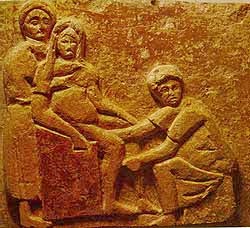
fear towards the Israelites grew from making them servants with heavy burdens to making them slaves. Their fear changed their relationship with Israelites. So we see that the mind that stays on the flesh will only reap more of the flesh. See the progression in verse 15, “Then the king of Egypt said to the Hebrew midwives, one of whom was named Shiprah and the other Puah, “when you serve as midwife to the Hebrew women and see them on the birthstool, if it is a son, you shall kill him, but if it is a daughter, she shall live.” The king’s mind was focused on the flesh. He was afraid for the future. He was afraid for the self-preservation of his people. So, he believed, the best way to ensure their safety against future military attack was to kill all the future warriors that could grow up to fight against them. So the King ordered the midwives to kill all the male children in order to preserve the kingdom of Egypt.

The mind that is set on the flesh leads to death. It does not start in death, but grows in the direction. The fleshly mind perverts truth and makes decisions that are not for the good others, but for the good of self. Pharaoh’s fear drove him to enslave the Israelite people and eventually seek their destruction. Fear leads to self-preservation, and a fear-driven self-preservation is one of the leading reasons for abortions. In 2004, researchers at the Guttmacher Institute, a pro-abortion organization, asked 1,209 women why they had obtained abortions. Seventy-four percent of the women responded with “having a baby would dramatically change my life” and seventy –three percent said, “I can’t afford a baby now.” The two most prominent reasons given for having an abortion were to preserve one’s current lifestyle. The fear of a dramatic change in life and the fear of financial difficulty were the two dominant reasons why these women chose to end the lives of their babies. The idea of self-preservation is not only seen in woman, but many men encourage their partners to have an abortion because they do not want to take responsibility for a child. Listen to Phil McCombs, a post-abortive father and a writer for the Washington Post,

I feel like a murderer. I was not by her side to support her. I turned my face away. My behavior was in all respects craven, immoral. The child would have inconvenienced me. I’d had my fun. He didn’t fit into my plans. His name, which is carved on my heart, was Thomas. I still grieve for little Thomas. It is an ocean of grief.

And listen to Jeff Bradford, who didn’t fight to preserve his lifestyle, but his reputation.

I hid and suppressed the realization that the only reason our oldest daughter was not alive today was due to my own cowardice. I went to my wedding, pretending to be an upright, moral young man with my bride dressed all in white. She was beautiful, and we looked great on the outside. No one could see the brokenness we were both hiding so well. We had aborted our first child just a few months before.

The reasons that women have abortions are very complex. It is impossible to know what brings people to make the decision to end a life. The mind is very powerful. And we know that when it is set on the flesh it will produce death. The flesh blinds the truth. This is the testimony of Scripture. Our culture perverts truth because the mind of our culture is set on the flesh. Our culture encourages people to fight and to save their
own lives, but in the end they will only to lose it. For Jesus says, “For whoever would save his life will lose it, but whoever loses his life for my sake will save it. For what does it profit a man if he gains the whole world and loses or forfeits himself?”

This is the lie of our culture. Our culture focuses on our individual needs. The American message encourages us to do whatever we can to fulfill our own individual desires. Watch commercials; listen to politicians, so much of their appeal is how your desires can be met. Fear and self-preservation are very powerful tools, but our greatest desires will never be met when we try to preserve our lives. We only can discover true joy when we delight in the Lord. For those who delight in the Lord will get the desires of their hearts.

Those on the other side of abortion see this reality. They sought to save their own lives, only to lose them. The guilt, shame and regret is crippling to men and women who have had abortions. But by God’s grace, he is continuing to call people to lose their lives, to lose their comfort, to lose their reputations, to gain the true life of peace. To set the mind on the Flesh is death, but to set the mind on the Spirit is Life. Second point, The Mind set on the Spirit is Life.


 The Mind Set on the Spirit is Life


The only way to change our culture is to turn people from the fear of suffering and losing their lives, to the fear of the Lord. I believe one of the reasons that women pursue abortion is that they are consumed with fear. Fear of change. Fear of loss. Fear of condemnation. Fear of pain. Fear produces hopelessness, and hopelessness produces awful decisions. We have to help people have the right kind of fear; the fear of the Lord. Let’s look at the courage of two young women who demonstrated the right kind of fear. Exodus 1:16, “When you serve as a midwife to the Hebrew women and see them on the birthstool, if it is a son, you shall kill him, but if it is a daughter, she shall live.” But the midwives feared God and did not do as the king of Egypt commanded, but let the male children live.” The women had a choice. They could choose to save their lives, by obeying the highest authority in the land or they could choose to obey the highest authority in the universe. These women made the right choice. They did not seek to save their own lives, but rather chose to fear the Lord. They knew that it could bring suffering into their lives. They knew that it could have even cost them their lives, but they were willing to lose their lives to save the lives of others.

In this way, the Hebrew midwives lived as an example pointing forward to Jesus Christ. For Jesus Christ laid down his life for his friends. He chose to die that others may live, and because Jesus obeyed the Father, God raised him from the dead. God showed favor to Jesus in the resurrection making him (as it says in Romans 8:29) the first-born of many brothers. God honored Jesus’s willingness to die in that if anyone would call upon the name of Jesus and trust him as Lord then they would be saved. Jesus chose to suffer and die so others could live. This is exactly what the Hebrew midwives did. They knew the cost, but feared God. So they chose obedience even in the face of potential death so that others could live, and God honored them for it.

Listen to verse 18, “So the king of Egypt called the midwives and said to them, “Why have you done this, and let the male children live?” The midwives said to Pharaoh, “Because the Hebrew women are not like the
Egyptian woman, for they are vigorous and give birth before the midwife comes to them.” So God dealt well with the midwives. And the people multiplied and grew very strong. And because the midwives feared God, he gave them families.” The very thing Pharaoh was concerned about was happening. The people multiplied and grew very strong. The actions of two Hebrew midwives helped the people of God grow. God also specifically honored the women by giving them families. They made a decision that should have cost them their lives, but God showed them favor and actually gave them the desires of their hearts.

The arguments put forward from the pro-abortion side are centered on individualism and self-preservation. The world says the decision to keep or take the life of a child belongs to the woman or with the woman and her doctor, but all life belongs to God. “None of us lives to himself or dies to himself. If we live, we live to the Lord, if we die, we die to the Lord. So then whether we live or die, we are the Lords (Rom 14:7-8). The reasons that women have abortions may be complex, but it is always wrong. Choosing to keep a child will change one’s life dramatically, it will bring financial hardships, and it will costs you, it may even bring judgment from others, but choosing life honors God. And God honors those who chooses life, but brings judgment on those who chose murder. This is grounded in our faith in God. Our faith that He exists and rewards those who love him. Hebrews 11:6, “And without faith it is impossible to please him, for whoever would draw near to God must believe that he exists and that he rewards those who seek him.” So we cannot please God, if we do not acknowledge Him. And when we do not acknowledge Him, we are given over to do things that are unspeakably awful, like the killing of unborn children. Romans 1:28, “And since they did not see fit to acknowledge God, God gave them up to a debased mind to do what ought not to be done…They were are full of envy, murder, strife, deceit, maliciousness.”

The only way to change the direction of the culture is to change their acknowledgement of God, to set the mind on the Spirit of God which brings life. It is not enough to stand on the sidelines. By standing on the sidelines, we are giving approval. Romans 1:32 goes on to say, “Though they know God’s righteous decree that those who practice such things deserve to die, they not only do them, but give approval to those who practice them.” There is no middle ground. You either fear God, like the Hebrew midwives, and choose life, or you choose to give approval to what God hates. And if we give approval for what God hates, we are storing up wrath for ourselves on the day of wrath when God’s righteous judgment will be revealed. We must set our minds on the Spirit and find life. We must help others turn from self-preservation to lose their lives for the sake of God and the sake of the unborn children made in his image, and you cannot help others until you set your mind on the Spirit.

My prayer is that through this message that you would become advocates for life. My prayer is that your
lives are so filled with grace and mercy that when a woman is contemplating this decision that she would be drawn to you because of your grace, and you give her the word of life. I pray that everyone here today would be an advocate for the Spirit. Set your mind on the Spirit, for the mind set on the Spirit is life and peace. Help others find life and peace.

For if we do not turn people from a mind set on the flesh it will only continue to escalate to death. Look at verse 22, “Then Pharaoh commanded all his people, “Every son that is born to the Hebrews you shall cast into the Nile, but you shall let every daughter live.” The mind set on the flesh will only produce death. For the mind set on the flesh is hostile to God, for it does not submit to God’s law. Indeed, it cannot. Those who are in the flesh cannot please God, but we know there is hope, for the next thing God reveals, after the pronouncement of the killing of children, is the birth of the deliverer, Moses. Let me close by quoting Pastor John Piper who says it so well:

   In the very darkest season of the worst child-killing, Moses was born. Moses,.. the deliverer. Moses, the ,    rescuer, the savior of the people. And then the prophet like Moses (Deuteronomy 18:15; Acts 3:22)—the   Son of God, Jesus Christ, the final decisive Rescuer, Savior, Deliverer—was born, and barely escaped the   slaughter of the babies in Bethlehem. He lived a perfect life and died for sinners and rose again. And here’s   one of the great differences between him and Moses. Moses delivered the people who were being      oppressed. Jesus delivers oppressed and oppressor. Moses delivered the hated race. Jesus delivers the        hated and the hater. Moses couldn't deliver the strangled babies or babies thrown into the Nile, but Jesus    delivers the babies, the mothers, the abortion providers, the irresponsible boyfriends. He loves and saves  every sinner who trusts in him. So let us join hands and say with a clear voice as one in Christ: there is a  better way to freedom than killing the babies. And that way is Jesus Christ.